MSP/Synth/Piano: Harder Music For Times Even (Joe Lasqo, Tom Nunn, and Paul Winstanley) w Warren Stringer, visuals, Sat 18 Jan, @ Crane House, Oakland, 8pm + Set 2: Aurora Josephson, “Jacob L”, Lisa Mezzacappa @ 9pm

The superb series at the Crane House (near Ashby Bart – for address/directions contact joe@joelasqo.com) has made it into one of the most interesting places to hear improv & new music in the Bay Area.

Would you buy a used skatch box from these guys?

I’m keenly looking to play again at this unique dance-studio venue, with its beautiful acoustics, for a great set of laptop/electro-acoustic improvs with virtuoso free-improv duo Music For Hard Times (Tom Nunn: invented instruments & Paul Winstanley: super-extended bass) on Sat 18 Jan at 8pm.

A recent great album from Music For Hard Times (Tom Nunn & Paul Winstanley) - Dogs

We decided to play under the rubric Harder Music For Times Even, but what’s emerged during our rehearsals for this date is a music that’s not hard at all, but rather, gently weird, open, unfolding, un-rushed — luminous, patchy, neither-existant-nor-nonexistant, like Princess Leia’s hologram or a rainbow seen in fog.

Friend - to M. F. (portrait of Morton Feldman by Philip Guston)… What's that he's smoking?

It’s a music I’ve never heard before, for which the closest reference might be Morton Feldman (had he been a full-on hippy…. on a different planet…).

This music makes me very happy and undefined, and it wants to make you feel happy and undefined as well.

Tom Nunn playing his invented instrument, The Crab

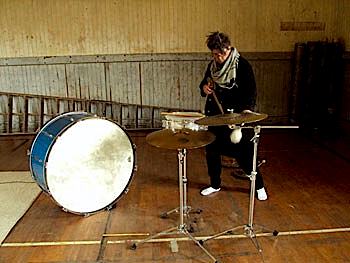
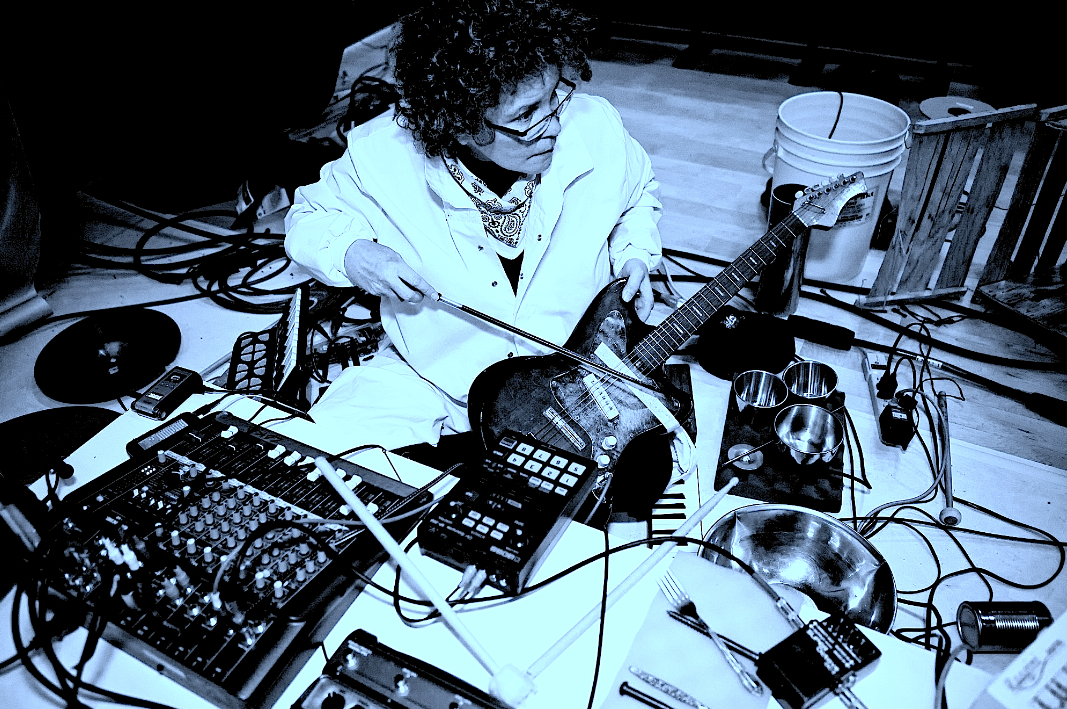
Tom Nunn (Bold Italic interview, bio), has designed, built and performed with original musical instruments since 1976, and has built over 200 instruments, including his latest obsession, the visually arresting Skatchbox.

This is your mind on Lukie Tubes Resonance Plates... Are You Experienced?

His instruments typically utilize commonly available materials, are sculptural in appearance, utilize contact microphones for amplification, and are designed specifically for improvisation with elements of ambiguity, unpredictability and nonlinearity.  Tom has performed extensively throughout the San Francisco Bay Area for over 30 years, as well as in other parts of the U.S., Canada, Europe, and New Zealand, both as soloist and with other musicians.  Tom also performs with T.D. Skatchit, RTD3, Ghost in the House, Music for Hard Times (duo with Paul Winstanley) and has appeared on a number of recordings, including his solo CD, Identity (2007), T.D. Skatchit & Company (2009) and Skatch Migration (2010) (Edgetone Records).  In 1998, he published Wisdom of the Impulse: On the Nature of Musical Free Improvisation.

Paul Winstanley performing at Berkeley Arts Festival, 16 Oct 2012 (photo: Michael Zelner)

Paul Winstanley is an improvising electric bass player from New Zealand who specializes in extended techniques. In addition to trying to make his bass sound like electronics he is interested in making electronic music that sounds like natural environments. He has several solo projects including Sci Hi (electronic feedback), Speed Cook (music from sound samples and non-musical sounds) and The Complete Recordings (artificial simulations of field recordings).

One of Paul Winstanley's outlandish solo albums

Paul lived in Auckland, New Zealand for 10 years where he was part of the growing local and national experimental/improvising music scene, playing in groups w/luminaries like instrument inventor Phil Dadson, percussionist John Bell, radical concert brass band The NZ Dominion Centenary Concert Band, folk icon Fats White, abstract electronic supergroup Plains and improvising electronic trio Audible 3. Paul was a founding member of Auckland improvising collective vitamin_s (Wikipedia, website), which has drawn improvisatory trios from a pool of 100+ members for a weekly concert series for over a decade. Paul was also active in the Houston avant-improv scene, before settling in San Francisco.

The Nunnery

As a duo, Music For Hard Times is more than the sum of its formidable parts and has not only performed regularly throughout the Bay Area over the last two years, but has recorded a series of brilliantly unclassifiable albums at Tom Nunn’s instrument-inventor’s laboratory and experimental music venue/studio, The Nunnery. Check out these one-of-a-kind sonic adventures at their label, Docking Station.

Joe Lasqo @ Meridian Gallery, 11 Jan 2012 (Photo: PeterBKaars.com, http://www.peterbkaars.com)

I’m keenly looking forward to exploring the further reaches of open and unfolding sonic space with them, using a sound mélange evoked from electronic and acoustic keyboards, MSP/laptop, spare percussion, and carved silences. My laptop-based AI improvising agent associate, Maxxareddu, will also assist from time to time.

Warren Stringer

It will also be our honor and pleasure to welcome the inimitable visual synthesis of maestro Warren Stringer (of Muse).

Those who have seen Warren at one of my previous shows or a Bay Area technorave know his unique mastery in combining art and algorithm for the real-time visual accompaniment of improvisatory music. (And the rest of you have something great to look forward to.)

L → R: Warren Stringer, Joe Lasqo, and Rent Romus, Luggage Store Gallery, 27 Dec 2012

Set 2 (9pm): Contra, Contra, Contra – trio of Aurora Josephson, “Jacob L”, Lisa Mezzacappa

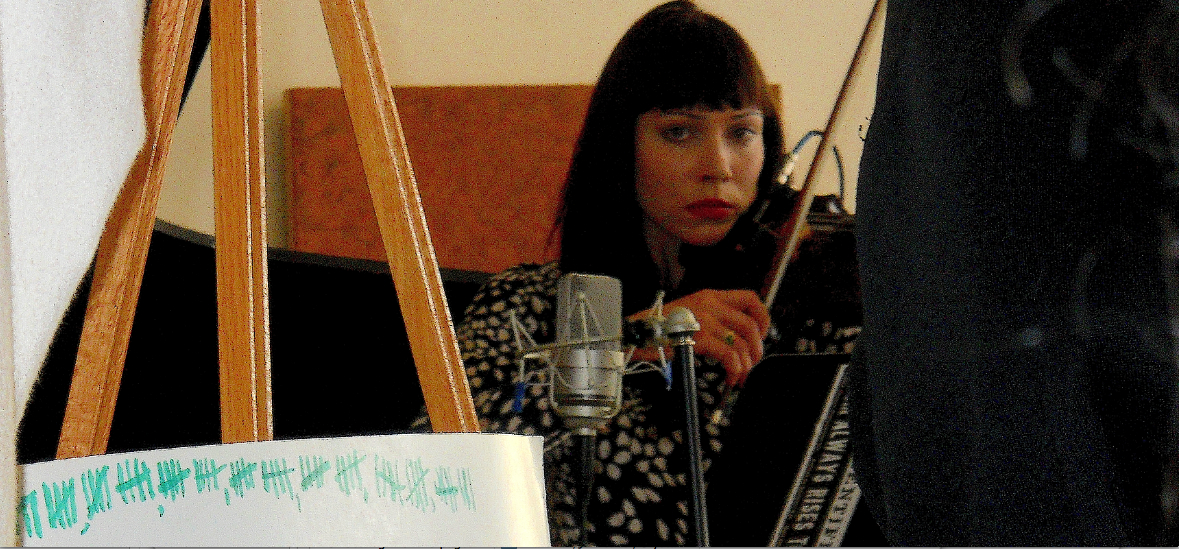
We’ll be followed by Contra, Contra, Contra, a monster trio of Aurora Josephson (extended-technique vocals), “Jacob L” (clarinets), & Lisa Mezzacappa (bass) for more improv.

Aurora Josephson and friend (photo by Myles Boisen)

Aurora Josephson is an accomplished musician, extended techniques vocalist and visual artist based in Oakland, California. Building on a foundation of operatic training and a BA in Music Performance from Mills College, Aurora has forged a bold vocal style that is uniquely her own. To unleash the limitless range of sonic possibilities in the voice, she employs a variety of extended and unconventional techniques drawn from the worlds of contemporary composition, improvisation, and rock. She’s performed and recorded with international talents like improvising musicians Martin Blume, Alvin Curran, Gianni Gebbia, Henry Kaiser, Joëlle Léandre, Phillip Wachsmann and William Winant, musical groups like Big City Orchestra, The Molecules, The Flying Luttenbachers and the Merce Cunningham Dance Company.

Other collaborators include: Bruce Ackley, Steve Adams, Liz Allbee, Myles Boisen, Bob Boster/Mr. Meridies, Kyle Bruckmann, Xopher Davidson, Ann Dentel, Elizabeth Gray, Phillip Greenlief, Vinny Golia, Matt Ingalls, Cheryl Leonard, “Jacob L”, Miya Masoaka (正岡みや), Myra Melford, Lisa Mezzacappa, Joe Morris, Tom Nunn, Larry Ochs, Brian Pearson, Noah Phillips, Jon Raskin, Gino Robair, John Shiurba, Damon Smith, Andrew Voight, Weasel Walter.

“Jacob L” will play clarinets.

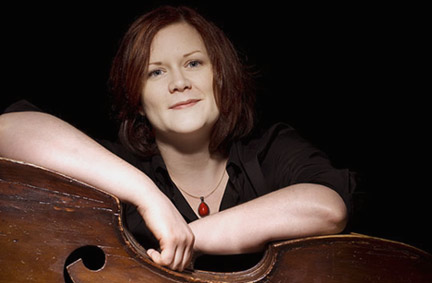
Lisa Mezzacappa

Lisa Mezzacappa is a San Francisco Bay Area-based bassist, composer, and musical instigator. An active collaborator and curator in the Bay Area music community, she leads her own groups Bait & Switch, Nightshade, the Lisa Mezzacappa Trio and the Tangle Trio, and co-leads the ensembles duo B., Cylinder, the Mezzacappa-Phillips Duo, and the Caribbean folk band Les Gwan Jupons. Lisa has released her music on the Clean Feed, NoBusiness, Leo, NotTwo, Evander, Odd Shaped Case and Edgetone record labels, and has recorded as a sideperson for the Tzadik, Kadima and Porto Franco labels. She collaborates frequently on cross-disciplinary projects in sound installation, film/video, sculpture and public music/art.

As curator, she programs the annual JazzPOP concert seres at the UCLA Hammer Museum in Los Angeles, now in its 9th year; and a live cinema series, Mission Eye and Ear, at Artists’ Television Access. She founded the Monday Makeout creative music series in the Mission District of San Francisco, and programs the Best Coast Jazz Composers series as a member of the artistic committee San Francisco’s Center for New Music. In 2012 she started the “Festival-of-Us,” an annual festival celebrating Bay Area creative jazz and improvised music. Recent projects include an avant-folk string band, The Interlopers; Eartheaters, a trio with Brooklyn vocalist Fay Victor; and BODABODA, a cross-planetary collaboration with Venice-based reed player/composer Piero Bittolo Bon.

Join us for two great free trios of unfettered improv and get very happy and undefined…

Joe

Posted in Uncategorized | Leave a comment

MSP/piano, w sax masters Steve Adams of ROVA Sax Quartet & Aaron Bennett (Sun 08 Dec @ Outsound.org’s SIMM Series, SF, 7:30pm) + Set 2: Daniel Pearce & Teddy Rankin-Parker duo, 8:30pm

Outsound: A New Sonic Collective for the 21st Century

I’m very excited to once more join sax masters Steve Adams and Aaron Bennett at Outsound’s SIMM Series at 7:30pm, Sun 08 Dec (Set 1) at the Musicians Union Hall, 116 9th St @ Mission, SF (map).

Yakitori-ya in the rain at night, Shimbashi (夜の雨の中で焼き鳥屋、新橋)

Outsound’s SIMM Series reminds me of cozy parties among friends at my favorite yakitori joint, nestled under the Shimbashi Bridge in Tokyo in the night rain… from the outside a few hints of warm light and laughter, on the inside a serious wild time. The difference is that, unlike the yakitori joint, the SIMM Series is a spaceship that travels to other musical dimensions.

An acoustic-centered sister of the Luggage Store Series, SIMM has brought the best cutting-edge acoustic jazz and avant-garde musicians in and out of the Bay Area to SF audiences and delivered one musical adventure after another.

(L → R) Joe Lasqo, Steve Adams and Aaron Bennett at the Makeout Room, 6 May 2013 (Photo by Michael Zelner)

It’s my honor to return to this series, and I’m especially excited to be doing so with Steve Adams and Aaron Bennett, whose highly disparate styles interlock in a unique fusion.

Steve Adams

Steve Adams needs little introduction to lovers of jazz and new music, having been a long-standing key player in various East & West Coast scenes. His work on various saxes, flutes, electronics and as a composer combines probing originality, playful improv structures and swing with a very specific angular momentum.

Steve Adams

Steve is best known as a member of ROVA Saxophone Quartet, whom he’s been with for more than 20 years. Steve is also a member of the Bill Horvitz Band, various Matt Small ensembles, and the Vinny Golia Large Ensemble, as well as leading his own projects.

Steve lived in Boston in the ’70s and ’80s, where he was a member of Your Neighborhood Sax Quartet, Birdsongs of the Mesozoic, and Composers in Red Sneakers among others. A remarkable collaboration with avant jazz bassist Ken Filiano, which we in the Bay Area have the pleasure of hearing on his swings to the West Coast, was formed in this period.

Steve’s versatility, powerful musical imagination, commanding technique, and personal warmth and great sense of humor make him a wonderful collaborator, and it’s been great to have my ears expanded by his beautiful ideas.

Aaron Bennett in Space

Aaron Bennett has been bending space in the Bay Area jazz and improvised music communities for more than 15 years. Beyond his studies in composition and performance of western music at California Institute of the Arts, Aaron has also studied and played the music of West Africa, Indonesia, India, and Traditional Japanese 雅楽 (Gagaku) music. He has performed throughout the United States and abroad including performances with Wadada Leo SmithPeter KowaldJohn ButcherDonald RobinsonMarco EneidiGianni GebbiaWeasel WalterAdam LaneLarry OchsSteve AdamsJohn RaskinVictoria WilliamsAphrodesiaLagos-RootsROVA Saxophone Quartet and many others.

Aaron Bennett in Time

Over the last year and a half it’s been my honor and pleasure to play in Aaron’s Electro-Magnetic Trans-Personal Orchestra and have my mind thoroughly blown by his remarkable compositions for improvising ensemble, utilizing his unique graphic notation. If you don’t know this band, download its first album (cover below) at http://emtpo.bandcamp.com/ today and hear what the fuss is about.

Electro-Magnetic Trans-Personal Orchestra (cover art: Nancy Bennett)

Kim Seok-Chul (김석철), shaman and hojoek (호적) virtuoso

We’ll open with  blast of high energy from Steve Adams’ piece In The Waterfall, inspired by Emma Franz’s great film Intangible Asset № 82, which documents Australian jazz drummer Simon Barker’s 7-year, 17-trip quest to find and meet the late Kim Seok-Chul (김석철), Korean shaman and virtuoso of the piercingly powerful Korean double-reed instrument hojoek (호적).

Bae Il-Dong (배일동), Korean Pansori (판소리) singer, who spent 7 years singing next to a waterfall to learn how to sing with force

On the long and winding road to eventual success in meeting Kim Seok-Chul (김석철), Simon Barker encounters another apostle of intensity, acclaimed singer of the Korean traditional opera pansori (판소리), Bae Il-Dong (배일동), who spent 7 years singing next to a waterfall to learn how to develop the spiritual force to match and overpower it.

Music critic John Shand once remarked that “If volcanos could sing, then they would sound like Bae Il-Dong.”

And if volcanoes could play Giant Steps, they would sound like Aaron Bennett and Steve Adams

Inspired by this kind of intensity, the improvisational structures of Steve Adams’ piece In The Waterfall challenge its players to burn through the waterfall by being in the waterfall, an experience you’ll not soon forget.

Anthony Braxton

Next we’ll present 2 original pieces “interpolated” into Anthony Braxton’s Ghost Trance Music piece, Composition #255.

Braxton’s Ghost Trance Music series lays track to interconnect the destinies of two marginalized groups in the struggle for the full decolonization of American culture, while at the same time taking complete advantage of the explosion of musical thinking that started in centers like Darmstadt, Paris and New York after the war.

Cosco Ghost Dance Petroglyphs from Site CA-INY-4836, the Gallery (Death Valley)

From the essay Like A Giant Choo-Choo Train System by Jonathan Piper (liner notes to 9 Compositions [Iridium] &  2006 [Firehouse 12 Records]):

Anthony Braxton (L) & Dave Holland (R)

“…In 1993 Braxton told Graham Lock he was looking for “a system of tracks, like a giant choo-choo train system that will show the connections, so where a soloist is moving along a track, that will connect to duo logics, trio logics, quartet logics. So, for instance, if you’re traveling from Composition 47, which is a small town, to a city like Composition 96, the model will demonstrate the nature of combinations and connections in between systems.”

The Ghost Dance

Things fell into place in 1995 after Braxton sat in on a Native American music course and studied the Nanissáanah (“Ghost Dance”) rituals promulgated by Native American prophet Wovoka in the late 1800s. For Braxton, the Ghost Dance had great resonance. “The Ghost Dance music, when it was put together, that came about in a time after the American Indian had been decimated, 98 percent of their culture destroyed,” Braxton recalls. “Various tribes came together and compiled whatever information they had left. And the Ghost Dance music was described as a curtain—one side is reality for us, and the other side is the ancestors. And the Ghost Dance music would provide a forum to connect with the ancestors. That had a tremendous impact on me.”  Drawing on the example of all night Ghost Dance ceremonies (and other world trance musics), Braxton looked to construct a “melody that doesn’t end” to serve as the train tracks to cohere his system. The Ghost Trance Music was born.”

Ghost Dance Song (Arapaho)

Following the performance tradition of Phillip Greenlief, under whose baton I had the honor to play this piece with Orchesperry in August at Berkeley Arts Festival, we’ll “interpolate” other pieces into the Braxtonian matrix, a procedure which introduces kaleidoscopic shards of color into the trance (see 32 min of that performance below).

Our interpolations on this occasion will send the piece in a wildly different direction and will lead off with the graphic-score state-transition-diagram composition for improvisers by Steve Adams, #30.

#30, Ⓒ Steve Adams

It’s total fun to play these witty and dynamic graphical games from Steve’s book.

Whale Form, © Aaron Bennett

We’ll also do the improv-ensemble composition Whale Form by Aaron Bennett. Like the “alphabet pieces” we do in Electro-Magnetic Trans-Personal Orchestra, it encodes the perfect amount of info in its specialized language to ensure the contradictory fusion of structure and openness, with each performance like a fresh encounter with a complex ecosystem in a new season.

Joe Lasqo @ Meridian Gallery, 11 Jan 2012 (Photo: PeterBKaars.com, http://www.peterbkaars.com)

I’ll contribute an improv composition combining musique concrète concepts with laptop synthesis and live acoustic instruments, Emergent 2, first heard earlier this year in performances at Berkeley Arts Festival and Trinity Chamber Concerts. Its 5-part series of transformations trace the emergence of complexity from clarity, sound from music, music from sound, & clarity from complexity.

Plus, of course there will be free improvs.

Set 2 at 8:30pm will be the indescribable duo of cellist Terry Rankin-Parker and percussionist Daniel Pearce. I have heard them play recently at the Luggage Store, and they will open your ears with sounds you’ve never dreamt of.

Originally from Chicago and/or other planets, they’ve recently moved to the Bay Area and describe themselves as “improvisers whose music considers friendship”. It is a very apt description, because the intensity of their telepathic musical rapport is unique and will hit you like a 2×4. You will hear original music of rare power.

Teddy Rankin-Parker

A Jimi Hendrix of the cello (and a graduate of the Oberlin Conservatory of Music), Teddy has performed, toured, and/or recorded with dozens of artists, including the International Contemporary Ensemble (ICE), Eighth Blackbird, Ensemble N_JP, Iron & Wine, Glen Hansard, Birthmark, OosImaginary Art Collective, the Kirtan Choir, the Chicago Sinfonietta, Joffrey Ballet, AACM, Chicago Folks Operetta, Opera Cabal, Renee’ Bakers Mantra Blue Free Orchestra, Henry Grimes, Chicago Modern Orchestra Project, and Nicole Mitchell’s Black Earth Ensemble.

Daniel Pearce

Daniel is a one-of-a-kind drummer, as well as a writer, who’s performed, toured, and/or recorded with numerous groups, including Tenebre, the Ghost Shirt, the Odilon Swan Ensemble, the Canyon Rays, Cardboard, and Ex-Nihilo.

His drumming redefines rhythmic gestures as primal grammatical acts that do not so much as keep time as create time.

Each of them is an original pathbreaker who’s developed a completely new language for their instrument, and the dialogue of these languages in the duo is unforgettable and will widen your definition of music (recent EP, Companion Pieces, Vol. 1).

Cover of Companion Pieces, Vol. 1, new EP by Teddy Rankin-Parker and Daniel Pearce — what lurks within?

This show will be a wild journey — look forward to take it together!

See you there…

Joe

Posted in Uncategorized | Leave a comment

MSP/Synth/Bots w Half-Human Quartet — Ritwik Banerji (ঋত্বিক ব্যানার্জী), Joe Laso and AI improvising agents Maxine & Maxxareddu (Sun 17 Nov @ The Nunnery, SF, 2pm) + Set 2: Tom Bickley, with guest appearance by Nancy Beckman, 3pm

The Nunnery

Note: We’ve switched sets since the original posting of this article, and are now on at 3pm.

We’re very excited to be part of the new series at The Nunnery, the recently-launched SF new music venue of instrument inventor Tom Nunn, specializing in experimental and invented instruments (additional show preview at http://www.examiner.com/article/tom-nunn-opens-his-research-lab-to-the-public).

Part of the Invented Instrument orchestra @ The Nunnery

The series takes place in the depths of his secret new-instrument research lab, and the performance space is surrounded by Tom’s latest creations. Twice a month he opens the lab up for performances on a Sunday afternoon and a Monday evening, and we look forward to a matinée performance there at 3pm, Sun 17 Nov (3016 25th St., San Francisco, CA 94110, between Florida and Alabama Streets, map)

A flock of skatchboxes fly by at The Nunnery

Tom Nunn (Bold Italic interview, bio), has designed, built and performed with original musical instruments since 1976, and has built over 200 instruments, including his latest obsession, the visually arresting Skatchbox.

Tom Nunn playing his invented instrument, The Crab

His instruments typically utilize commonly available materials, are sculptural in appearance, utilize contact microphones for amplification, and are designed specifically for improvisation with elements of ambiguity, unpredictability and nonlinearity.  Tom has performed extensively throughout the San Francisco Bay Area for over 30 years, as well as in other parts of the U.S., Canada, Europe, and New Zealand, both as soloist and with other musicians.  Tom also performs with T.D. Skatchit, RTD3, Ghost in the House, Music for Hard Times (duo with Paul Winstanley) and has appeared on a number of recordings, including his solo CD, Identity (2007), T.D. Skatchit & Company (2009) and Skatch Migration (2010) (Edgetone Records).  In 1998, he published Wisdom of the Impulse: On the Nature of Musical Free Improvisation.

¾ of the Half-Human Quartet - (L → R): Joe Lasqo, Ritwik Banerji (ঋত্বিক ব্যানার্জী) & Maxxareddu, 25 Jul 2013 @ Outsound New Music Summit (Photo: PeterBKaars.com, http://www.peterbkaars.com)

Following on our debut at the recent 12th Outsound New Music Summit festival, I’m excited to once again play as a member of the Half-Human Quartet — AI improvising agents Maxine & Maxxareddu, as channeled by Ritwik Banerji (ঋত্বিক ব্যানার্জী) of Berkeley’s CNMAT & myself.

Ritwik Banerji (ঋত্বিক ব্যানার্জী, L) & Rob Frye (R) @ the Ivy Room, 26 Jan 2011

One inspiration for what we and our non-human colleagues are going to do sonically is the following video from the Cornell AI lab showing two chatbots kitted out in machinima avatars going at it. They have quite an interesting discussion:

Conversation is perhaps the most universal joint improvisatory activity, and what our musicbot routines do is something similar to what these chatbots do linguistically, in the musical sphere.

Joe Lasqo @ Meridian Gallery, 11 Jan 2012 (Photo: PeterBKaars.com, http://www.peterbkaars.com)

I raided a cupboard of techniques ranging from blackboard architectures and, especially, computational grammars, from my old work in expert systems development and natural language processing, to create Maxxareddu.

Improv Grammar Diagram from "The WIsdom of the Impulse", by Tom Nunn

Ritwik brought his own insights into heuristics techniques, machine/human learning, and astromusicology to create Maxine.

Ritwik and I will join Maxine and Maxxareddu’s conversation from time to time with our physical instruments (sax + RD-300NX keyboard).

Tom Bickley

Set 1 at 2pm will be the sublime Tom Bickley, playing contrabass recorder, recorder, EWI wind synth, radios, and laptop.

Tom Bickley (bio / site) composes electro-acoustic music, plays and teaches recorder, performs with Three Trapped Tigers (with recorder players David Barnett and Judy Linsenberg), Gusty Winds May Exist (with shakuhachist Nancy Beckman), co-founded and directs the Cornelius Cardew Choir, is a curator emeritus of the Meridian Gallery music series, and is on the Library Faculty (music, philosophy and political science) at CSU East Bay. His education includes degrees in music, theology, and library and information science and the Certificate in Deep Listening.

Tom Bickley and friend (photo by Nancy Beckman)

As a special treat, Tom will bring his new stonking big contrabass recorder.

Day of the Contrabass Recorders….?

Unholy spawn of a Lust ohne Tabu between a massive wood organ pipe and a periscope, this unique instrument amazed me when I saw Anna Petrini play it at a recent Other Minds festival, and I can’t wait to hear what Tom does with it.

…Or Day of the Triffids…?

Just as a bass clarinet or a contrabass clarinet is a very different instrument to a normal clarinet, the contrabass recorder opens up a completely new wind universe, and its “finger holes” are so far apart that a special system of hole-stopping flaps is needed, providing unique percussive possibilities.

Among the other pieces which Tom will perform is a special quadrophonic version of his Coincidence of Birds, Insects and Weather for EWI wind synth, digital samples and NOAA weather radio, a fantastically evocative piece which I had the pleasure of hearing recently at its Berkeley Arts Festival premier.

Tom will also be joined by Nancy Beckman for one piece, The Tip of the Iceberg, for shakuhachi and electronics.

Nancy Beckman

Nancy Beckman creates performance pieces, plays and teaches the shakuhachi, and performs with the Cornelius Cardew Choir. Her education includes an undergraduate degree in East Asian Studies from Wesleyan University, a master’s in interarts from SFSU and ordination to teach shakuhachi from Myōan-ji (明暗寺, the famous “Temple of Light & Darkness” of shakuhachi history) in Kyoto.

The Gate of Light & Darkness at Myōan-ji (明暗寺門)

The Gate of Light & Darkness at Myōan-ji (明暗寺門)

Walk through the gate-less gate and join us for a  Sunday afternoon of sonic adventure at one of SF’s most unique new venues — The Nunnery!

Denizens of The Nunnery welcome you...

Denizens of The Nunnery welcome you...

Look forward to see you there…

Joe

Posted in Uncategorized | Leave a comment

MSP/Piano w Aaron Bennett’s Electro-Magnetic Trans-Personal Orchestra (Fri 22 Nov @ Mynah Music, Oakland, 8pm) + Set 2: Medium Size Band (Brett Carson, Josh Marshall, Jon Myers, Jacob Peck)

Mynah Music

Aaron Bennett’s phenomenal post-jazz ensemble Electro-Magnetic Trans-Personal Orchestra returns to the East Bay at 8pm, Fri 22 Nov @ Mynah Music (543 Athol Ave. (between Cleveland St. & Brooklyn Ave., near Lake Merritt), Oakland, CA 94606 – map)

It’s aways a tremendous energy boost to play with Aaron’s EMTPO, and I look forward with special pleasure to bringing his fantastic charts to Mynah Music’s dynamic news series.

If you’ve already heard the first album of Aaron Bennett’s unique compositions released by Electro-Magnetic Trans-Personal Orchestra (cover below), you’re already coming to this great show. If not, run, don’t walk, to get a copy at http://emtpo.bandcamp.com/ and hear what the fuss is about.

Electro-Magnetic Trans-Personal Orchestra (cover art: Nancy Bennett)

Among Aaron’s many stellar contributions to the Bay Area improv and new music scenes (like sax trio arrangements of Bollywood standards) are fantastic “breathing chart” compositions for large improvising groups that deliver heightened coherence and adventure at the same time. They stand as Himalayas of group improv music. And Electro-Magnetic Trans-Personal Orchestra is the Mt. Everest.

Vapor Trails of Structure in Electro-Magnetic Trans-Personal Improv...

To quote Aaron: “The members of this ensemble utilize the electro-magnetic field of their collective mind to attain a unitive transcendent state of sonic consciousness and in turn, create sublime and/or unusually expanded sonic experiences for their listeners.”

The electro-magnetic field is tuned and amplified by means of unique “breathing chart” compositions using a special graphic notation Aaron has designed for large improvising ensembles to focus and unleash aural energies. The resulting sound is like nothing else and has amazed audiences in a string of orgone-accelerating Bay Area performances over the last year.

(For a more detailed interview with Aaron about this music, please check out Craig Matsumoto’s post: Aaron Bennett’s Electro-Magnetic Improv).

Aaron Bennett in Space

Bio note: Saxist/composer Aaron Bennett has been bending space in the Bay Area jazz and improvised music communities for more than 15 years. Beyond his studies in composition and performance of western music at California Institute of the Arts, Aaron has also studied and played the music of West Africa, Indonesia, India, and Traditional Japanese 雅楽 (Gagaku) music. He has performed throughout the United States and abroad including performances with Wadada Leo SmithPeter KowaldJohn ButcherDonald RobinsonMarco EneidiGianni GebbiaWeasel WalterAdam LaneLarry OchsSteve AdamsJohn RaskinVictoria WilliamsAphrodesiaLagos-RootsThe Rova Saxophone Quartet and many others.

Aaron Bennett in Time

He leads his own groups Go-Go-FightmasterElectro-Magnetic Trans-Personal Orchestra and performs in the Oakland Active OrchestraLisa Mezzacappa’s Bait & SwitchVijay Anderson Quartet, and Guerilla Hi-Fi. Aaron has composed for large ensembles, chamber groups, plays, films, dance performances, wind quintet, saxophone quartets and trios as well as pieces for solo instruments.

In addition to Aaron Bennett (sax & compositions), the line-up for this show will also include:

Bishu Chatterjee (বিশু চ্যাটার্জি) – bass

Bishu Chatterjee (বিশু চ্যাটার্জি)

Ron Heglin – trombone

Ron Heglin (photo by Tom Djll / Djll Pixels)

Jeff Hobbs – violin, or cornet, or…?

Jeff Hobbs (L) & Bob Marsh (R)

Darren Johnston – trumpet

Darren Johnston

Joe Lasqo – piano & laptop

Joe Lasqo @ Meridian Gallery, 11 Jan 2012 (Photo: PeterBKaars.com, http://www.peterbkaars.com)

Bob Marsh – accordion (and spiritual guidance counselor)

Bob Marsh performing in Sonic Suit #1, Outsound New Music Summit, 2011 (Photo- PeterBKaars.com, http-:www.peterbkaars.com)

Christina Stanley – violin

Christina Stanley performing in the Vexations Re-Vex'd 22-hour Satie improv marathon, Berkeley Arts Festival, 24 Mar 2013 (photo: Joel Deuter)

Set 2 will be Medium-Size Band, the collective of Brett Carson, Josh Marshall, Jon Myers, and Jacob Peck

Formed in 2012, the Oakland-based Medium-Size Band has dedicated itself to the exploration of novel formal structures and directed improvisations. Acting as a composer’s collective in which each member contributes pieces to the pool, the MSB draws on a diverse set of techniques aiming toward group communication and the channeling of creative energy. Each individual member’s unique background contributes to the eclecticism and freedom of movement between different genres and musical perspectives.

Brett Carson

Brett Carson (piano) – Brett’s work draws from a wide variety of musical traditions, reflecting the influence of Anthony Braxton, Tim Berne, John Zorn, Olivier Messiaen, Philip Glass, Claude Vivier, Sun Ra, and others. The composition-improvisation continuum is explored through traditionally notated structures, graphic scores, and improv game concepts. He is originally from Georgia and spent time working in the Atlanta experimental music scene before moving to California to pursue graduate studies in Composition. He is currently based in Oakland, and studies at Mills College with Roscoe Mitchell, Zeena Parkins, Fred Frith, Chris Brown, and Les Stuck.

Josh Marshall

Josh Marshall (tenor sax) is an Oakland-based saxophonist and composer/improviser. His work involves architectural innovation, narrativity, systematic improvisatory practice, and live digital media. He has studied with Roscoe Mitchell, Fred Frith, Pauline Oliveros, Evan Parker, Zeena Parkins, Butch Rovan, I.M. Harjito, and Steve Adams of the ROVA Saxophone Quartet. Joshua has played and/or recorded with Opera Wolf, Rent Romus’ Lords of Outland, Architect/Enchantress, Bill Noertker’s Moxie, Medium Sized Band, ELL3, Cheer Accident, Josh Allen’s Deconstruction Orchestra, Key West, Mister Sister, Ikue Mori (もりいくえ), Robocop, the Andrew Weathers Ensemble, Modest Machine, and MDK. His music has been featured in festivals and conferences nationwide, including Providence Pixilerations events, the 2010 International Computer Music Conference and 2013’s Outsound Summit. Joshua graduated from Brown University, earning a B.A. through the MEME program, and holds an M.F.A. in music from Mills College.

Joshua has devised several long-form works under the “Mythopoetics” heading, the ambition of which is to unfold abstract narratives in real-time by working within improvisatory systems determined by conceptual constraints particular to the subjects involved. Highlights include Volume II, a series of “Free Jazz Ballets” inspired by Charles Mingus, and Volume IV (Pharaoh Lunaire), which syncretizes a host of trinities (Sanders/Ayler/Coltrane, Webern/Berg/Schoenberg) while repurposing the form of Schoenberg’s famed melodrama.

Jon Myers

Jon Myers is a composer and percussionist from Boston, MA interested in fractal and cyclic forms.  He plays in various traditional and contemporary contexts from jazz and Javanese gamelan to new music chamber and percussion ensembles in addition to performing with radio-feedback instruments and computer programs of his own devising.  He is currently studying composition at Mills College in Oakland, CA. His composition Mobile was premiered in Oct 2013 at the Berkeley CNMAT.

Jacob Peck (L) and Jennifer Wilsey (R) at The Luggage Store, 21 Jun 2012

Jacob Peck is a guitarist from Las Vegas, NV. He’s currently based in Oakland, CA where he studies with Fred Frith & William Winant at Mills College. His music follows in the lineage of Sun Ra and Karlheinz Stockhausen — a “Cosmic Spirit Music” inspired and informed by jazz, jamming, bird song, Bach, Jimi Hendrix, and the reality of interwoven realms.

Join us for an evening of post-jazz improv like you’ve never heard before, at one of Oakland’s most intriguing new venues: Mynah Music

Look forward to see you there!

Joe

Posted in Uncategorized | Leave a comment

MSP/Piano w NY-based vocalist & sound artist Viv Corringham & percussionist extraordinaire Suki O’Kane (Wed 23 Oct @ Berkeley Arts Festival, 8pm) + Set 2: IMA (今), duo of Jeanie-Aprille Tang & Nava Dunkelman, @ 9pm

I’m keenly looking forward to joining NY-based British vocalist and electronic sound artist Viv Corringham and the Bay Area’s maestra of neo-gaku percussion Suki O’Kane for an evening of Inverse Tribbles and so much more….

The show will be at the East Bay’s indispensable focal point for new music, Berkeley Arts Festival (2133 University Avenue, Berkeley, CA – map) on 8pm, Wed 23 Oct.

Viv Corringham

Our program will include a 6-verse mini-renga-kai, improv games, AI-driven reactive soundscapes, deviant sample-melting, and deepening confusion between words, utterance, sound, and music.

Viv Corringham (R) & Andrea Parkins (L) performing at Douglass Street Music Collective, NYC, 13 Aug 2013

Viv Corringham has worked internationally since the early 80s, creating music performances, audio installations & soundwalks, using as her tools a gorgeous voice, a wide-open imagination, field recordings, and live electronics.

For a taste, click below to experience her multi-media collaboration with Elio Martusciello:

Viv Corringham's Soniferous Garden, Walker Art Center, MN, Jul 2013 - An aural expedition guide for World Listening Day

She’s interested in exploring people’s special relationship with familiar places and how that links to an interior landscape of personal history, memory and association.

Viv Corringham

Her ongoing project Shadow-Walks has been presented in gallery shows from New York to Istanbul to Hong Kong:

Viv Corringham's Shadow-Walks

“In the Shadow-walks project I go to places and ask local people to take me on walks that are special for them in some way.  I record our conversations as we walk together.  Later I retrace the person’s walk on my own and attempt to “sing the walk” through vocal improvisations. These recordings are edited together to make the final sound piece. I also collect any objects I find on the person’s route.”

For an example of the multi-media convergence of walking, song and remembrance, see her evocative commemoration of collaboration with late British thaumaturge and percussionist Paul Burwell, Together Then Created A Journey That Both Forgot:

Viv’s wonderful new album of shadow-walks from 3 continents, Walking, will be available hot off the press at this show (we’ll be using some of its material from the unique sound environment of Hong Kong in piece #3).

Viv is a maestra of blending strongly place-evoking field recordings with cozy/haunting vocal lines of uncommon beauty and invention. This album of shadow-walks is the place to hear the amazing results.

Viv Corringham's brilliant new album, Walking

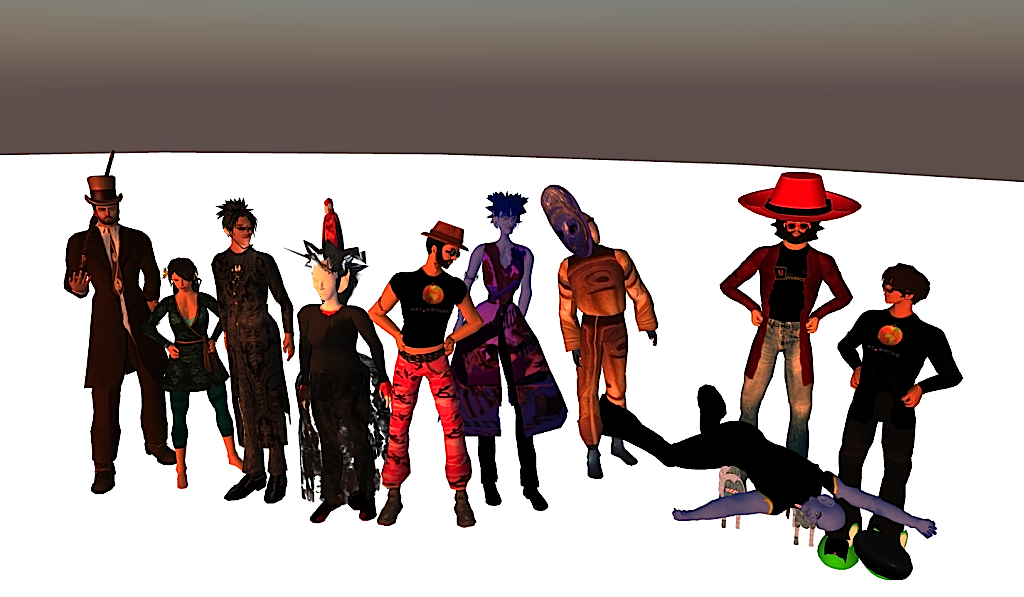
Not limited to roaming physical space, Viv’s travels extend to virtual space, including the notable Avatar Orchestra Metaverse project, meeting regularly with Pauline Oliveros and other happy mutants to play audio-visual instruments in Second Life.

Avatar Orchestra Metaverse — Zonzo Spyker, aka Viv Corringham (center)

Viv’s training and awards include an MA in Sonic Art with Distinction from Middlesex University & a BA in Theatre Design from Nottingham Trent University. She’s a certified teacher of Deep Listening, having studied with Pauline Oliveros. Viv is a 2012 and 2006 McKnight Composer Fellow; other grants and awards have come from Jerome Meet the Composer, the English & Irish Arts Councils, Jazz Services, Millennium Funding, London Arts Board, Chisenhale Awards, and others.

Suki O'Kane

Suki O'Kane

Suki O’Kane is a classically trained mallet percussionist, a composer and an instigator working with artists from a wide array of of music, movement and public art genres. One of the founding members of the lo-fi sampling ensemble The Noodles (with Michael Zelner), Suki plays percussion with Moe! Staiano’s Moe!kestra!, Dan Plonsey’s Daniel Popsicle, Big City Orchestra and is an ensemble member of Thingamajigs, performing new works by Edward Schocker, Dylan Bolles and Zachary James Watkins.

Suki O'Kane

Suki has performed live and recorded with She Mob and the side projects of its co-founder Sue Hutchinson: mad folk duo Junior Showmanship and it’s alter-ego, speed-metal Winner’s Bitch. She has performed in realizations of Jon Brumit’s Vendetta Retreat, and with Lucio Menegon in his Split Lip, Soundtrack Instumentals and Strangelet projects. Her long-running conversation about intermedia with Sarah Lockhart is occasionally expressed in drumkit duo and percussion trio performances of SL Morse.

Her work in theater includes three commissions for Theatre of Yugen with playwright Erik Ehn: Frankenstein (2003), The Cycle Plays (2007) and Cordelia (2011). She is a collaborator in Ehn’s Soulographie project.

Suki O'Kane

She works in partnership with House of Zoka, a live recording project that has documented over 13 years of creative new music in the Bay Area, and since 2003 has been curating performances of live music and film, such as The Illuminated Corridor, a nomadic public art project that creates streetscapes of live experimental music and performative projection and Music by the Eyeful, the indoor performance series exploring the work of intermedia artists. She has collaborated with Neighborhood Public Radio to present NOVA, a culminating event of NPR’s exhibition American Life at the 2008 Whitney Biennial, and with the Overdub Club, an ensemble made of performative filmmakers Alfonso Alvarez, Thad Povey, and musician Lucio Menegon.

Joe Lasqo @ Meridian Gallery, 11 Jan 2012 (Photo: PeterBKaars.com, http://www.peterbkaars.com)

Rounding out the ensemble will be myself, using piano, laptop, and solkaṭṭu (சொல்கட்டு), assisted at times by my laptop-based AI colleague, Maxxareddu.

Viv Corringham

We’re planning to start off with Viv’s piece Service, a sophisticated game for 3 or more, unfolding from simple rules based on experimentation, self-limitations, listening, and integration.

Written as a set of sections and directions that put a prismatic twist on the types of procedural compositions pioneered by Pauline Oliveros, this piece has a wonderful origami/pinball feeling as the rules unfold and players bounce from state to state into a balanced(?) mesh.

We’ll also do a 6-verse mini-renga-kai, a form I’ve had the pleasure of exploring with a series of wonderful musical partners in recent months.

The outer automorphism of S₆ permutations

The piece will comprise 6 short duets which will pair each musician with every other twice and employ the game-like shifting-time rules of Cage’s Two², extended with a new renga-kai methodology to kaleidoscopically expand the palette of timbres, instruments, and events.

John Cage and D.T. Suzuki (鈴木 大拙 貞太郎)

Renga-kai (連歌会) is a new form with extended rules based on some of the “renga pieces” of John Cage, and their unique transformations, not only of Japanese verse forms for alcohol-soaked group poetry improv based on structures of 5 + 7 + 5 + 7 + 7, but also of concepts like “duet”, “listening” and “time”.

Time displacement: Ø

It generates a game that, like go (碁), is rich in strategy despite relatively simple rules.

Time displacement: t-1

Time displacement: t-२

Having used this renga-kai methodology with a variety of wonderful musicians since premiering it recently with clarinetist Jacob Lindsay and guitarist Kristian Aspelin, I’m thrilled at the new improvisational vistas and completely different colors of time that it opens up, producing a uniquely beautiful sense of flow as the players move the game pieces of their musical gestures on an invisible board.

We’ll honor the renga tradition of alcohol-assisted creativity, by demarcating these sections with ceremonial libations (which may lead to some interesting musical results…).

Time displacement: t-三

For more details on renga (連歌) & Cage, see: this post.

Bao Shan ("bun mountains") of the Cheung Chau Island Bun Festival (長洲包山節)

Next is Island Line / Bao Shan (島綫/包山), a free improv in a reactive Hong Kong soundscape under the control of my AI improvising friend Maxxareddu.

Climbing the Bun Mountain to get the luck

Viv and I both have each collected field recordings from living and working in the unique and marvelous sound environment of Hong Kong.

Tai Hang Fire Dragon (大坑舞火龍)

Tai Hang Fire Dragon (大坑舞火龍)

Some of Viv’s materials from the piece Island Line, on her album Walking, and some of my field recordings from the Cheung Chau Island Bun Festival (長洲包山節), Tai Hang Fire Dragon (大坑火龍), etc., will be combined a dynamic soundscape under the control of my laptop-based associate Maxxareddu, who’ll launch place-based islands of sound to drive us forward along lines suggested by improvisational event-grammars and his analysis of our playing as he listens.

¾ of the Half-Human Quartet - (L → R): Joe Lasqo, Ritwik Banerji (ঋত্বিক ব্যানার্জী) & Maxxareddu, 25 Jul 2013 @ Outsound New Music Summit (Photo: PeterBKaars.com, http://www.peterbkaars.com)

Maxxareddu may also sit in on our last piece, my Triple Inverse Tribble #1.

Ernst Jacobsthal

Using a triple-threaded event architecture of 128 events and strategies abstracted from Indian rhythmics, this piece intertwines pieces of the binary exponential series and Jacobsthal-Lucas numbers* into a moiré’d event tapestry with unexpected resolutions and resonances.

"Scientific games" of Édouard Lucas, researcher into the Towers of Hanoi, prime numbers, etc.

* For those who like maths, Jacobsthal-Lucas numbers, like Fibbonacci numbers, are a Lucas sequence. J-L numbers can be expressed by the relation:

L[n] = 2ⁿ + (-1)ⁿ

Some of the score apparatus for Triple Inverse Tribble #1, by Joe Lasqo

The rehearsals and design process for this music have been very great fun, and it’s going to be a remarkable set.

IMA (今) performing Thin Film - Nava Dunkelman (ナヴァ・ダンケルマン, L) and Jeanie-Aprille Tang (鄧恬怡, R), photo by Mido Lee

Following in Set 2 at 9pm will be IMA (), the duo of Jeanie-Aprille Tang (鄧恬怡) & Nava Dunkelman (ナヴァ・ダンケルマン), who bring a fierce focus on the NOW MOMENT to their powerful deep-soundspace explorations.

I’m completely chuffed to share the bill with this wonderful percussion and electronics duo, who have played many barrier-shattering shows at The Lab, Berkeley Arts Festival, SIMM Series and elsewhere. Whether exploring trajectories of lyrical destruction or ethereal otherworldliness, their journey is always a brilliant thrill-ride full of sonic surprises.

IMA in their own words:

“I·MA [ii-ma] 今.  瞬間.

Hardware electronics and percussion.

Mirroring. Non-Retrograde. Reflection. Modulation. Paralleling. Echoes and Speech.

Omittance of identifiable objects for conversations between electronics and percussion counterparts.

overlap. repetition. disoriented messages. deconstruction. reconstruction. non-linear time. ”

Jeanie-Aprille Tang (鄧恬怡), photo by Mido Lee

Jeanie-Aprille Tang (鄧恬怡) is an electro-acoustic composer and improviser. Born in Hong Kong, she gravitates to rhythms of construction sites, roaming traffic, inaudible conversations, and airplanes. Natural and synthetic worlds are the polar opposites in her sonic practice. Her instrument is a collection of individual acoustic objects and electronic hardware. With an acoustic approach of mental and muscle memories in an electro-acoustic setting, coexistence and interference between natural and synthetic sounds are developed at the moment when acoustic sounds are modulated and overlapping itself in unstable manner and movement in time. She studied at Mills College with focus in electronic composition and hardware electronics.  Her interests are slow wave, new colour, irregular heartbeats, and circuitry.

Nava Dunkelman (ナヴァ・ダンケルマン), photo by Mido Lee

Nava Dunkelman (ナヴァ・ダンケルマン) is a Bay Area percussionist and improviser. Born in Tokyo, and raised in a multi-cultural environment by an American father and Indonesian mother, Nava’s musical interests span the globe from Japanes taiko (太鼓) to Indonesian gamelan to American marching band, and from classical to contemporary to the avant-garde. Nava studied percussion under Eugene Novotney at Humboldt State University before attending Mills College, where she studied with William Winant, as well as Fred Frith, Maggi Payne, Zeena Parkins, and David Bernstein, among others.

Since graduating with a degree in music performance in 2013, Nava has performed and collaborated with John Zorn, William Winant, Fred Frith, Chris Brown, Dominique Leone and many others, as well as formed the improvisational trio Dapplegray with Jeanie-Aprille Tang (恬怡) and Tara Sreekrishnan, which debuted in 2012 at The Stone in New York City. She also is a member of two marvelous duos: DunkelpeK with Jacob Pek, and IMA () with Jeanie-Aprille Tang (恬怡). Through improvisation, Nava enjoys discovering her own musical language by exploring experimental approaches to communication, progression, and space.

Join us for unforgettable sonic explorations in neo-gaku and beyond.

じゃまたね。。。

Joe

Posted in Uncategorized | Leave a comment

MSP/Piano: Renga Games – Cage’d & UnCage’d: Cage’s Two² w Patti Deuter • Renga-kai (連歌会) for 9 musicians • w dancer Nan Busse (Berkeley Arts Festival: Sat 05 Oct | CNM: Mon 07 Oct | Two² only: Palo Alto house concert, Sat 28 Sep)

Fu Nanihito Renga, an example of a 100-section / 100-artist renga form, 1525 A.D., Kanazawa-city collection (賦何人連歌、大永5年(1525)金沢市)

Patti Deuter and I are very excited to present contrasting musical explorations of the unusual and fascinating Japanese group poetry-improv form renga (連歌): one of John Cage’s renga-based masterpieces, Two², and the new Renga-kai (連歌会) improvisational form for 9 musicians, combining synthesized, vocal, instrumental, and concrète sounds across an electroacoustic spectrum — especially as we’re performing them in two of the master foundries for the Bay Area’s current new music ferment:

—————————————————————————————————

8pm, Sat 05 Oct, 2013 at Berkeley Arts Festival (2133 University Avenue, Berkeley, CA – map)

7:45pm, Mon 07 Oct, 2013 at Center for New Music (55 Taylor Street, San Francisco, CA – map)

We’ll present Two² alone in an additional concert in this series:

8pm, Sat 28 Sep, 2013, house concert, Palo Alto (If you’d like to come to the Palo Alto concert, please contact me at joe@joelasqo.com as soon as possible for directions)

—————————————————————————————————

We’ll be joined by one of the Bay Area’s most exciting dancers, Nan Busse, for all concerts, and and for the 05 Oct and 07 Oct concerts at Berkeley Arts Festival and CNM, we’ll also perform as part of a 9-piece ensemble, viz.:

Nancy Beckman (shakuhachi & percussion), Tom Bickley (recorder, electronics/radios & percussion), Rachel Condry (clarinets), Patti Deuter (piano & toy piano), Ben Kreith (violin), Joe Lasqo (MSP/laptop, piano, mṛdangam, & solkaṭṭu), Sangita Moskow (sarod), Suki O’Kane (percussion), Dean Santomieri (guitars & voice)

—————————————————————————————————

Part 1: John Cage: Two², performed by Patti Deuter & Joe Lasqo, with dance by Nan Busse

Patti Deuter performs Cage's "Four Walls" @ Berkeley Arts Festival

My partner in crime for Cage’s two-piano/two-pianist piece Two² will be the delightful and brilliant pianist Patti Deuter, ringleader of last September’s Satie/Cage Vexations at Berkeley Arts.

Patti Deuter (left, at toy piano): "Violette Nozieres, Revenant". (Performance-Installation with toy piano & projection of Surrealist Book; Patti Deuter & Anna Wexler @ Pierre Menard Gallery, Cambridge, MA, 2009) Photo: ©Jane Wang

Often found in Paris as well as California, and a student of Eliane Lust’s, Patti is an indefatigable macherin of the new music and piano scenes of the Bay Area. From her studio-cottage nestled in the trees, where everything is keyed to one of four vibrant synesthetic colors (forming, I would say, a visual rootless 13th chord in second inversion… Scriabin would approve), passionate strains of Rzewski, Cage, Wolff, and other masters of 20th and 21st century piano escape to infuse the air.

John Cage and D.T. Suzuki (鈴木 大拙 貞太郎)

As is well known, John Cage was heavily influenced by Zen Buddhism and Japanese culture in general, and his two-piano masterpiece, Two², is a remarkable musical re-imagining of the traditional Japanese linked-verse improvisation form, renga (連歌).

With beginnings in the time of the Man’yōshū (万葉集), c. 760 A.D., renga evolved into a very sophisticated game played by connoisseurs who used its 5-line stanzas consisting of a 5-7-5 syllable haiku (俳句) + a 7-7 syllable response in an interplay of group-improvised linked-verse, exchanged among the members of a (usually sake-soaked) poetry party (not unlike the similar game of cadavre exquis played in graphical form by the Paris surrealists).

Renga paper of poet Nishiyama Sōin (西山宗因連歌懐紙)

Japanese poetry fiends took renga to remarkable heights of sophistication, defining an elaborate aesthetic of seasonal symbolism, pivot-stanzas referring to moon and cherry blossoms, and special gold-and-silver dusted papers of different shapes, sizes and colors, corresponding to distinct parts of the symbolic program, to brush their poems onto whilst sipping from cups of sake brought to them sushi-boat-style by special garden streams constructed for this purpose.

John Cage at the piano

Cage’s luminous and serene Two² for 2 pianists uses the 36-stanza kasen (歌仙) form of renga, re-imagining each of the 5-line stanzas as 5-measure musical units, each filled with 5 or 7 piano sound-events which replace the syllables of the original poetic form. It has been called a “rock garden of sound”.

Say hello to my little friend...

Like many of the other Cage “number pieces”, the timing of the musical events in Two² is not strictly determined, but unlike the “time bracket” approach to indeterminacy found in many of the number pieces, here instead Cage sets up a marvelous game of simple rules to let the two pianists create an interlinked joint control of fluid time, a game in which they can support or subvert each other, creating meditative kaleidoscopic ripples of piano sound which will be uniquely different in each performance.

Similar to Western classical music forms having 3 movements, the 36-stanza kasen renga (歌仙連歌) form employs 3 sections, called Jo-ha-kyū ().

John Cage performs "Water Walk" on "I've Got A Secret"

The form also includes three “moon stanzas” (#5, #14, & #29) and two “flower stanzas” (#17 & #35), which will be interpreted by dancer Nan Busse.

We’ll honor the renga tradition of alcohol-assisted creativity, by demarcating these sections with ceremonial libations (which may lead to some interesting musical results…).

Nan Busse

Nan Busse has been creating dance-based art works since receiving her MFA from UC-Irvine (“a long time ago…”). Collaborating with choreographer Christopher Beck, she made pieces performed at Centerspace (Project Artaud) and New College; and with her partner, poet Tobey Kaplan, participated in the Link inter-disciplinary performance series.

Emily Mizuno (L), Nan Busse (M), and Peggy De Coursey (R) prepare backstage for the performance of Nguyễn Dance Company at the Metropolitan Theatre in Hồ Chí Minh City, Việt Nam

Since about 1999 she has been unable to stop dancing – thanks to Yvonne Caldwell, Evelyn Thomas, Roger Dillahunty, Georgia OrtegaJohn Tanner, and the great Cassie Terman, and has toured in Việt Nam and the US with Nguyễn Dance Company. She works as an Education & Arts Therapist in the East Bay.

—————————————————————————————————

Part 2: New piece, Renga-kai, performed by Renga-9 Ensemble, with dance by Nan Busse

We’ve invited 7 musicial comrades to join us in the creation of a new renga-based nonet piece, Renga-kai (連歌会, or “renga party”).

Carol Simmons, polymer clay, 36 Permutations on Black (carolsimmonsdesigns.com)

The piece will comprise 36 short duets which will pair each musician with every other and employ the game-like shifting-time rules of Cage’s Two², along with a new renga-kai methodology to kaleidoscopically expand the palette of timbres, instruments, and events.

Time displacement: Ø

It generates a game that, like go (碁), is rich in strategy despite relatively simple rules.

Time displacement: t-1

Time displacement: t-२

Having premiered this renga-kai methodology with clarinetist Jacob Lindsay and guitarist Kristian Aspelin recently, I’m thrilled at the new improvisational vistas and completely different colors of time that it opens up, producing a uniquely beautiful sense of flow as the players move the game pieces of their musical gestures on an invisible board.

As in Two², the “moon and flower” stanzas will be danced by Nan Busse and players will honor the grand tradition of intoxicated inspiration with ceremonial libations.

Time displacement: t-三

The full ensemble:

Nancy Beckman

— Nancy Beckman (shakuhachi & percussion)

Nancy creates performance pieces, plays and teaches the shakuhachi, and performs with the Cornelius Cardew Choir. Her education includes an undergraduate degree in East Asian Studies from Wesleyan University, a master’s in interarts from SFSU and ordination to teach shakuhachi from Myōan-ji (明暗寺, the famous “Temple of Light & Darkness” of shakuhachi history) in Kyoto.

The Gate of Light & Darkness at Myōan-ji (明暗寺門)

The Gate of Light & Darkness at Myōan-ji (明暗寺門)

Tom Bickley

Tom Bickley (recorder, electronics/radios & percussion)

Tom Bickley (bio / site) composes electro-acoustic music, plays and teaches recorder, performs with Three Trapped Tigers (with recorder players David Barnett and Judy Linsenberg), co-founded and directs the Cornelius Cardew Choir, is a curator emeritus of the Meridian Gallery music series, and is on the Library Faculty (music, philosophy and political science) at CSU East Bay. His education includes degrees in music, theology, and library and information science and the Certificate in Deep Listening.

Rachel Condry

Rachel Condry (clarinets)

Rachel Condry is an Oakland based clarinetist, improviser, composer and educator.  Her work advocates for small sounds, lost or forgotten in the noisy drones of the modern soundscape.

Rachel’s musical interests span from pop to classical to free improvisation to acousmatic composition. She is often found collaborating with other disciplines such as art, poetry and dance.

She writes open scores and performs with the improvising quartet, Gestaltish who are preparing to release their first album. In 2005, Rachel made her Carnegie Hall debut with The Matt Small Chamber Ensemble, a group that blends jazz and classical approaches with free improvisation.  She’s also a founding member of the San Francisco Composers Chamber Orchestra with whom she has frequently been featured as a soloist, as well as the principal clarinetist of the Golden Gate Park Band, the oldest civic band in the nation.  Rachel holds an MFA from Mills College and a BA and BM from Oberlin College and Conservatory.

— Patti Deuter (piano & toy piano) – see above

Joe Lasqo @ Meridian Gallery, 11 Jan 2012 (Photo: PeterBKaars.com, http://www.peterbkaars.com)

Joe Lasqo (MSP/laptop, piano, mṛdangam & solkaṭṭu)

Ben Kreith plays by the water, as the ancient masters of the Chinese gǔqín (古琴) zither did to sharpen their ears

— Ben Kreith (violin)

Violinist Benjamin Kreith has performed as a chamber musician, soloist and orchestra player throughout the US and Europe. He’s premiered solo works at the Strasbourg and Marseille festivals and performed as a guest artist with the Ying and Muir Quartets.

Ben helped to found the Ensemble CGAC in Santiago de Compostela, and has also performed with sfSound, Barcelona 216, and the Harvard Group for New Music. Recently he spent several years in Montana as a member of the Cascade Quartet and concertmaster of the Great Falls Symphony. He has taught at the Escola de Música de Barcelona and served as artist-in-residence at the University of California, Davis.

Sangita Moskow

Sangita Moskow (sarod)

Sangita Moskow’s musical career reflects a personal global consciousness and delight in the wonderful variety of artistic expression.

Her sarod studies took place between 1969-1985 with classical North Indian maestro Ali Akbar Khan. Vocal training is a major component of classical Indian music study, and Sangita found herself combining vocals with the sarod early on.

Collaboration with Swiss clarinetist Hermann Bühler has inspired many compositions, some featured on their CD, Sojourn. Sojourn toured Europe for more than a decade and also received Swiss support for a 17-concert tour in Mexico.

Yakshi, the duo of Sangita & Mihai Manoliu, produced a CD of compositions and improvisations, preserving the rasa (रस, emotional power or “flavor”) of Indian rāgas via Manoliu’s use of modified tunings for the guitar to supply a harmonic underpinning for the sarod.

Planet Tree Music Festival producer/pianist/composer Lawrence Ball and Sangita duo-perform totally improvised music based on Indian rāgas, with the timbral overlaps of the sarod and piano providing a fertile ground. Their last performance occurred at the Planet Tree Music Festival at Pete Townsend’s studio on the outskirts of London.

Collaboration with electronic/ambient artist Robert Rich resulted in the CD Yearning, a combination of alāp (अलाप, unmetered free rhythm) on sarod with an electronic soundscape to create a unified field between Hindustani tradition and electronics; Yearning was voted a top CD for meditation and yoga by Yoga Journal.

Although primarily known as a sarodist, Sangita began her Indian studies as a percussionist on the North Indian classical tabla drums. She studied with Phil Ford, Pandit Shankar Ghosh (শংকর ঘোষ) and Zakir Hussain (زاكير حسين). She plays tabla with mandolinist Phil Lawrence and can be heard on the CD Mandolin Mandalas. Sangita played for a year in Lou Harrison’s gamelan orchestra at Mills College, and studied more gamelan in Bali. In 2010 Sangita began learning the bodhran, the drum that accompanies Irish music.

Not content with East-West synthesis, Sangita also pursues East-East synthesis, especially in combination with the Japanese shakuachi, performing with shakuhachist Stephen Ross in Hawaii, England, Europe and locally in a long musical collaboration. These Still Waters, Sangita’s CD collaboration with the late New York shakuhachi player Genji Itõ (伊藤源次) is another wonderful example of Sangita’s East-East work and one of my personal favorites.

Among other collaborators too numerous to note in detail, ones which may be of particular interest to readers of this blog are: Tom Nunn, Polly Moller, Aurora Josephson, Karen Stackpole, Loren Kiyoshi Dempster, Genny Lim and Pan Asian Orchestra, Doug Carroll, and Guillermo Galindo, with whom she has given some stunning recent performances at Berkeley Arts Festival and the Chapel of the Chimes Garden of Memory.

Sangita’s received more than 10 awards for musical composition from the ASCAP Foundation as well as a Subito grant from the American Composers Forum.

Suki O'Kane

Suki O'Kane

Suki O’Kane (percussion)

Suki O’Kane is a classically trained mallet percussionist, a composer and an instigator working with artists from a wide array of of music, movement and public art genres. One of the founding members of the lo-fi sampling ensemble The Noodles (with Michael Zelner), Suki plays percussion with Moe! Staiano’s Moe!kestra!, Dan Plonsey’s Daniel Popsicle, Big City Orchestra and is an ensemble member of Thingamajigs, performing new works by Edward Schocker, Dylan Bolles and Zachary James Watkins.

Suki has performed live and recorded with She Mob and the side projects of its co-founder Sue Hutchinson: mad folk duo Junior Showmanship and it’s alter-ego, speed-metal Winner’s Bitch. She has performed in realizations of Jon Brumit’s Vendetta Retreat, and with Lucio Menegon in his Split Lip, Soundtrack Instumentals and Strangelet projects. Her long-running conversation about intermedia with Sarah Lockhart is occasionally expressed in drumkit duo and percussion trio performances of SL Morse.

Her work in theater includes three commissions for Theatre of Yugen with playwright Erik Ehn: Frankenstein (2003), The Cycle Plays (2007) and Cordelia (2011). She is a collaborator in Ehn’s Soulographie project.

She works in partnership with House of Zoka, a live recording project that has documented over 13 years of creative new music in the Bay Area, and since 2003 has been curating performances of live music and film, such as The Illuminated Corridor, a nomadic public art project that creates streetscapes of live experimental music and performative projection and Music by the Eyeful, the indoor performance series exploring the work of intermedia artists. She has collaborated with Neighborhood Public Radio to present NOVA, a culminating event of NPR’s exhibition American Life at the 2008 Whitney Biennial, and with the Overdub Club, an ensemble made of performative filmmakers Alfonso Alvarez, Thad Povey, and musician Lucio Menegon.

Dean Santomieri at Berkeley Arts, 12 Aug 2011 (Photo by Neo Serafimidis)

Dean Santomieri (guitars & voice)

Dean Santomieri has been working with electronic music and musique concrète since 1971, as well as creating multi-image pieces, videos, and super-8 and 16mm films. Dean formed the electro-acoustic performing duo Donkey Boy in the 90s with Luther Bradfute, which employed live electronic music, slides or video, story-telling, costumes, and props in their many Bay Area performances. He’s collaborated with Joyce Todd to form the baroque performance group Theater of Memory, and also performed with Malcolm Mooney (the original singer with the German prog-rock group Can) & The 10th Planet, providing electronics and guitar. Dean formed a multi-media group with musicians Bruce Anderson, Karen Stackpole and David Kwan, for live performance of his short stories (narration accompanied by live music and video). This ensemble’s initial show, The Boy Beneath the Sea, was performed numerous times in the Bay Area, leading to his first CD release, followed by Crude Rotation and others.

More recently, Bay Area audiences have been captivated by Dean’s telepathic duo work with violinist and electronics maestra Thea Farhadian, and Dean will in fact have just returned from playing with Thea in Berlin for this show. I was highly honored to have Dean & Thea play in this spring’s Vexations [Re-vex’d] improv marathon as well.

Another notable collaboration to which Dean has recently added impressive ectoplasmic heft is the uniquely paranormal ensemble Ghost In The House, where his unclassifiable musical narratives show what happens when Ken Nordine’s word jazz meets Jung’s Red Book.

Join some great players for a serene and surprising game of structured interdimensional drift to the places you can’t get to any other way.

じゃまたね。。。

Joe

Posted in Uncategorized | Leave a comment

MSP/Piano: Scelsi + Renga-kai (連歌会) improvs w “Jacob L” / Kristian Aspelin (Sat 07 Sep, @ Crane House, Oakland, 9pm), + Set 1: Henry Kaiser (solo) @ 8pm

Giacinto Scelsi at the piano

The superb series at the Crane House (for address/directions contact me at joe@joelasqo.com) has made it into one of the most interesting places to hear improv & new music in the Bay Area.

I’m excited to play again at this unique dance-studio venue, with its beautiful acoustics, for a set of laptop/acoustic improvs with Jacob L and guitarist Kristian Aspelin on Sat 07 Jan at 8pm.

Giacinto Scelsi

We’ll be presenting improvs based on pieces and concepts from two giants of 20th-C music, Giacinto Scelsi & John Cage, as well as improvs based on the pitch-class permutation concepts of Allen Forte and Robert Morris, which have formed the basis of the “Morton Feldman sound” (among many others), taking some of the most intriguing developments of late 20th-C avant-garde music far beyond their original classical contexts.

The result will be a sonic infinity pool of space, pitch, timbre… and more space, that will leave your ears and mind refreshed and sharpened.

Giacinto Scelsi

Born to an aristocratic Southern Italian family in 1905, Giacinto Scelsi (d. 1988) was perhaps the strangest member of the remarkable school of post-war Italian composers, also including Nono, Berio, Bussotti, and Maderna, a school whose brilliance has been getting more exposure here in the Bay Area in recent years by sfSound, among others.

His music is marked by a supreme concentration on single notes, combined with an acute sense of form and elaborated through microtonal shadings, harmonic allusions, and variations in timbre and dynamics, creating a deceptively simple music of whose power is both stark and subtle.

Giacinto Scelsi

A virtuoso pianist and compositionally influenced by Futurist Luigi Russolo, dodecaphonists like Alban Berg, and Scriabin, Scelsi came into conflict with the Fascists and decamped to Switzerland during World War II. After the war, he suffered a mental breakdown. His therapy consisted of playing a single note on a piano over and over again, listening to its resonance and decay, and this was to open the door to his new style.

After Scelsi began composing again, the musical ideas of Asia (in particular, India and Tibet) assumed a large role in his music, and he wrote a string of piano pieces based on ostinato pulses, clusters, shimmering overtone mixtures, and resonance effects, in which extreme power and tension can be drawn from a single note — a note which is not a point, but a process, whose pitch, timbre, and other qualities could change in time without its losing coherence.

Later after the war, the various types of microtonal glissandi and extended timbre-melodies from Indian and other musics which captivated Scelsi moved him beyond the piano to strings and his brilliant Divertimenti for solo violin.

From the excellent bio essay by Todd Michel McComb (here) re this period:

“Scelsi was fifty years old in 1955, and in the midst of establishing his epoch-making style which was to yield a succession of individual masterpieces in the 1960s…. his aristocratic position freed him from financial worries… [and] he had traveled extensively in India and Nepal, learning much of eastern yoga and mysticism… By this time Scelsi had restricted himself to linguistic expression only through French poetry – he had disavowed any analysis or explanation of himself or his music, indeed refusing much personal contact as well as photographs. He had moved to an apartment in Rome, overlooking the ancient Roman Forum, and had established an environment in which his intuition was to blossom apart from the mainstream of music…”

Scelsi's Ensō (シェルシの円相)

This passage highlights one of Scelsi’s eccentricities — he never let his image to be shown in connection with his music, but identified himself by a line under a circle, derived from the Japanese Zen symbol ensō (円相)

Sufi playing the Ney (ناي‎), painting by Zonano

In this period, Scelsi wrote many pathbreaking short pieces for wind instruments. This music includes not only the influence of sonic philosophy from India and East Asia, but also of the Middle East, an interest since his first encounter with Middle Eastern music in Egypt in 1927, adapting many aspects of the dusky-sounding Middle Eastern ney (ناي) flute so beloved by Sufis to the clarinet. He also elaborated a method of working out compositions in improvisation, recording them, and later notating them. His requirements led to specialized string notation, the use of a variety of mutes for brass, slow glides outside of normal time between notes, quarter-tone electric organs, and many other innovations.

In later years, Scelsi had quite a few friendships and interactions with American composers, esp. the 60’s expat scene (Alvin Curran, Frederic Rzewski, John Cage, Morton Feldman, Earle Brown, among others), and was an inspiration for Ennio Morricone‘s (yes, that Ennio Morricone) free-improv Gruppo di Improvvisazione di Nuova Consonanza, but his music did not begin to receive wide-spread attention until the last decade of his life in the 80’s, via a notable series of concerts and premiers in Köln and elsewhere.

Jacob, Kristian and I will be doing 4 improv pieces inspired by Scelsi’s 3 Studi for Clarinet, 3 Pezzi for Saxophone, and his final, deeply enigmatic work for bass instruments, Maknongan. It’s been a fantastic experience for me to explore how to add the dimension of laptop/electronic sound into our improvs based on these originally purely acoustic pieces.

John Cage and D.T. Suzuki (鈴木 大拙 貞太郎)

As is well known, John Cage was heavily influenced by Zen Buddhism and Japanese culture in general, and some of the most remarkable results of this  are his musical re-imaginings of the fascinating traditional Japanese linked-verse form, renga (連歌).

Renga paper of poet Nishiyama Sōin (西山宗因連歌懐紙)

With beginnings in the time of the Man’yōshū (万葉集), c. 760 A.D., renga evolved into a very sophisticated game played by connoisseurs who used its 5-line stanzas consisting of a 5-7-5 syllable haiku (俳句) + a 7-7 syllable response in an interplay of group-improvised linked-verse, exchanged among the members of a (usually saké-soaked) poetry party (not unlike the similar game of cadavre exquis played in graphical form by the Paris surrealists).

Say hello to my little friend...

Lately I’ve been extending Cage’s renga-methodology with various improvising musicians, using a new renga-kai (連歌会, “renga-party”) form, and this collaboration with Jacon and Kristian is one of the happiest results.

We’ll be playing a mini-renga-kai of improv duets based on the final 6 poems in the climactic kyū () section of a 36-verse renga-sequence, using an event structure abstracted from Cage’s two-piano renga piece Two² (which I’ll be performing with fellow pianist Patti Deuter later this year in Oct).

Jacob and Kristian’s spare and intently focused playing styles are perfect to bring out the inner vastness which can be contained within the exactly 31 events of each piece. The result is a luminous sonic space within which hangs a shifting mobile of distinct sound-colors.

A few Klangfarben drift by...

Z-relations among pitch-class sets in Elliott Carter, Fragment #2, analyzed by Jeremiah Goyette

Finally, we’ll be presenting improvs based on the pitch-class permutation concepts of concepts of Allen Forte and Robert Morris. The music-theoretic concepts of these two giants have been critical to 20th-C music in many areas of 12-tone theory, algorithmic and computational approaches to pitch transformation, etc.

Pitch set-classes related by abstract inclusion, from Rule-Following, Pre-Compositional Environments, thesis by Rohan Drape

We’re going to put them to good work in a set of kaleidoscopic transformations of two pitch-class sets that generate rich sonic universes from very small kernels. Again, Kristian and Jacob, with their long history of shimmering improvs based on pitch-class permutations, are the perfect partners in this aesthetic exploration.

“Jacob L” will play clarinets.

Kristian Aspelin

Kristian Aspelin – guitar

Starting as a rock guitarist, Kristian’s brain got fried courtesy of John Coltrane, sending him off into an extended exploration of jazz harmony, theory, and composition, while playing in numerous combos and large ensembles.

This eventually led him to realize his goal was beyond… in the worlds of non-idiomatic free improv.

Using an unadorned, pure sound as his template, Kristian rigorously explores and extracts from his instrument the melodies, rhythms, harmonies, and textures needed to express or complement a given moment of the improv.

Kristian has studied with a number of leading improvisers in various genres, including Joe Morris, Steve Lantner, Gerald Cleaver, Larry Ochs, Bill Bell, Morris Acevedo, Liberty Ellman, David Fiuczynski, Bennett Friedman, and John Schott. He has performed and/or recorded with artists such as Damon Smith, Kyle Bruckmann, Joe Morris, Scott Looney, Weasel Walter, Jerome Bryerton, Paul Hartsaw, Marco Eneidi, Ralph Carney, Henry Kaiser, Moe! Staiano, and Phillip Greenlief.

Joe Lasqo @ Meridian Gallery, 11 Jan 2012 (Photo: PeterBKaars.com, http://www.peterbkaars.com)

I keenly look forward to join Jacob and Kristian to explore this unique material for you listening pleasure.

Henry Kaiser

Set 1 (8pm): Henry Kaiser

I am honored to share the bill with the incomparable Henry Kaiser, one of my favorite musicians and a true pioneer of the guitar.

In 1977, Henry Kaiser founded Metalanguage Records with Larry Ochs (Rova Saxophone Quartet) and Greg Goodman. In 1979 he recorded With Friends Like These with Fred Frith, a collaboration that lasted for over 20 years. In 1983 they recorded Who Needs Enemies, and in 1987 With Enemies Like These, Who Needs Friends? They joined with fellow experimental musicians John French, and English folk-rocker Richard Thompson to form French Frith Kaiser Thompson for two eclectic albums, Live, Love, Larf & Loaf (1987) and Invisible Means (1990). In 1999 Frith and Kaiser released Friends and Enemies, a compilation of some of their earlier work together with new recordings.

Henry Kaiser

In 1991, Henry went to Madagascar with fellow guitarist David Lindley, where recorded with Malagasy musicians. Three volumes of this music were released by Shanachie under the title A World Out of Time.

Since 1998, Henry has been collaborating with trumpeter Wadada Leo Smith in the “Yo Miles!” project, releasing a series of tributes to Miles Davis’ 1970s electric music. This shifting aggregation has included musicians from the worlds of rock (guitarists Nels Cline, Mike Keneally and Chris Muir, drummer Steve Smith), jazz (saxophonists Greg Osby and John Tchicai), avant-garde (keyboardist John Medeski, guitarist Elliott Sharp), and Indian classical music (tabla player Zakir Hussain).

Henry has appeared on more than 250 albums and scored dozens of TV shows and films. He was awarded a Grammy for his work on the Beautiful Dreamer tribute to Stephen Foster.

Henry Kaiser & friend huddle for warmth

In 2001, Henry went to Antarctica on a National Science Foundation Antarctic Artists and Writers Program grant. He has subsequently returned for nine more deployments to work as a research diver.

US Antarctic Writers & Artists Program Parka Patch

His underwater camerawork was featured in two Werner Herzog films, The Wild Blue Yonder (2005) and Encounters at the End of the World (2007), which he also produced, and for which he and David Lindley composed the score. Henry served as music producer for Herzog’s Grizzly Man (2005). He was nominated for an Academy Award for his work as a producer on Encounters at the End of the World.

Join us for a memorable night of encounters at (and slightly beyond) the end of the world….

Joe

Posted in Uncategorized | Leave a comment

MSP/Synth/Bots w Half-Human Quartet & NoiseJam Homebrew Instrument Orchestra (Sat 10 Aug, 9pm, @ Noisebridge Hackerspace Benefit, SF)

Noisebridge, San Francisco’s Hackerspace, is having another epic benefit party, to include eclectic performers, interactive art, and more.

If you don’t know Noisebridge, see the end of this post for a brief summary of its importance to the Bay Area maker community.

¾ of the Half-Human Quartet: (L → R) Joe Lasqo, Ritwik Banerji (ঋত্বিক ব্যানার্জী) and Maxxareddu, 25 Jul 2013 @ Outsound New Music Summit (Photo: PeterBKaars.com, http://www.peterbkaars.com)

Fresh from our debut at the recent 12th Outsound New Music Summit festival, I’m excited to once again play as a member of the Half-Human Quartet — AI improvising agents Maxine & Maxxareddu, as channeled by Ritwik Banerji (ঋত্বিক ব্যানার্জী) of Berkeley’s CNMAT & myself, + visuals by Warren Stringer.

Ritwik Banerji (ঋত্বিক ব্যানার্জী, L) & Rob Frye (R) @ the Ivy Room, 26 Jan 2011

One inspiration for what we and our non-human colleagues are going to do sonically is the following video from the Cornell AI lab showing two chatbots kitted out in machinima avatars going at it. They have quite an interesting discussion:

Conversation is perhaps the most universal joint improvisatory activity, and what our musicbot routines do is something similar to what these chatbots do linguistically, in the musical sphere.

Joe Lasqo @ Meridian Gallery, 11 Jan 2012 (Photo: PeterBKaars.com, http://www.peterbkaars.com)

I raided a cupboard of techniques ranging from blackboard architectures and, especially, computational grammars, from my old work in expert systems development and natural language processing, to create Maxxareddu.

Improv Grammar Diagram from "The WIsdom of the Impulse", by Tom Nunn

Ritwik brought his own insights into heuristics techniques, machine/human learning, and astromusicology to create Maxine.

Ritwik and I will join Maxine and Maxxareddu’s conversation from time to time with our physical instruments (sax + RD-300NX keyboard).

Warren Stringer

It will also be our honor and pleasure to welcome the inimitable visual synthesis of maestro Warren Stringer (of Muse).

Those who have seen Warren at one of my previous shows or a Bay Area technorave know his unique mastery in combining art and algorithm for the real-time visual accompaniment of improvisatory music. (And the rest of you have something great to look forward to.)

L → R: Warren Stringer, Joe Lasqo, and Rent Romus, Luggage Store Gallery, 27 Dec 2012

Johny Radio

I’m also honored to join the digital section of the NoiseJam Orchestra at this event on laptop under the conduction of wonderful homebrew sound device guru & DJ Johny Radio. Other sections of the orchestra will include anything homebrew, invented, patched, or coded – so be prepared for anything from circuit-bent toys to tin-can-resonator banjos and Frankenvegetables.

These unique sonic events unfold for your listening pleasure at Noisebridge, 2169 Mission St., SF (map/directions), 9:00-9:55pm, Sat 10 Aug.

Lesley Flanigan & Tristan Perich leading the Loud Objects workshop @ Noisebridge

Our set as NoiseJam Orchestra is part of a much larger eclectic music/dance program starting from 4pm and going to late, also including:

Carl & Beatrice, dinnerwiththekids, DJ Nobody, Dull Richards, Free Reed Vibrating Society / Music in Motion (under the baton of the inimitable Bob Marsh), Fruit Helmet, Jeremy Hatch, The Majors, Mock Church, Pet the Tiger, Pinched Nerve, and Thunderground Collective

For details about the music schedule and more at this fantastic event for Noisebridge Hackerspace, see: here. (Open admission, but please donate, that is the point).

Noisebridge

If you can’t come, you still have the opportunity to donate to keep SF’s beloved hackerspace in good financial health (various ways to do this outlined: here).

Noisebridge

Why is Noisebridge important? What do you get when you support it?

I can’t say it better than Danny O’Brien, Noisebridge’s treasurer:

“Sure, you get the world’s craziest hackerspace, not-even-run by anarchist lunatics who built WikiLeaks and run one of the biggest Tor nodes and work for the EFF and construct X-Ray Lasers from spare parts and inspire SciFi books and start 3D printing companies and make kombucha and robots, and you get to come to it 24/7 and we’ll give you a key, and share our software and our classrooms and teach you how to fix your laptop or use our woodshop or share our library or use the darkroom or cook some food or have a free shell account or throw a party or chase a robot or paint a picture or make a dress. But you could do that without paying $10 anyway, right?

Well, maybe only for another few months…”

It's alive…!

Join us 9-9:55pm, Sat 10 Aug to hear musicians meet music AIs, and FM synthesis meet Frankenvegetables and/or ???

And donate in person or per instructions here.

Posted in Uncategorized | Leave a comment

MSP/Piano: w Donald Robinson @ SIMM Series, SF (Sun 25 Aug, 8:30pm) + The Deconstruction Of What You Know (Allen/Kaiser/Miller/Winant, 7:30pm)

Outsound: A New Sonic Collective for the 21st Century

TIME CORRECTION: Lasqo/Robinson is Set 1, 7:30pm, Deconstruction of What You Know is Set 2, 8:30pm

After a series of private performances at the musical rituals of the secret society IBIM, Don Robinson and I are presenting some of the initial findings of our paranormal researches into rhythm Outsound’s SIMM Series at 8:30pm, Sun 25 Aug (Set 2) in the Musicians Union Hall, 116 9th St @ Mission, SF (map)

Outsound’s SIMM Series reminds me of cozy parties among friends at my favorite yakitori joint, nestled under the Shimbashi Bridge in Tokyo in the night rain… from the outside a few hints of warm light and laughter, on the inside a serious wild time. The difference is that, unlike the yakitori joint, the SIMM Series is a spaceship that travels to other musical dimensions.

An acoustic-centered sister of the Luggage Store Series, SIMM has brought the best cutting-edge acoustic jazz and avant-garde musicians in and out of the Bay Area to SF audiences and delivered one musical adventure after another. It’s my honor to return to this series, and I’m very excited to be doing so with Don Robinson.

Don Robinson performing w the Kris Tiner Trio @ In The Flow Festival, Sacramento, 14 May 2012 (photo by George Thomson)

Don Robinson performing w the Kris Tiner Trio @ In The Flow Festival, Sacramento, 14 May 2012 (photo by George Thomson)

Described by Coda as a “percussive dervish”, Don Robinson is a technical master of the drums. He’s a stalwart of the of San Francisco Bay Area avant-garde jazz scene, playing and recording with many of the area’s past and current improvisational players, from saxophonists John Tchicai, Marco Eneidi and Larry Ochs to koto player Miya Masaoka (正岡みや) and pianist Matthew Goodheart, and with prominent visitors like Cecil Taylor, Wadada Leo Smith, George Lewis, trumpeter Raphé Malik and Canadian pianist Paul Plimley. Much of this work has featured the combination of Robinson and bassist Lisle Ellis as rhythm section: ‘the best bass-drums tag team on the scene’ (Jazz Times). His longest musical association, dating from the 1970′s, was with the late tenor saxophonist Glenn Spearmann.

Don Robinson (up), Fred Frith (down), & Larry Ochs (L) @ Starline Social Club, 31 Aug 2012

Born in Boston, Massachusetts in 1953, Don first studied classical percussion at the New England Conservatory. During the early 1970′s he served his musical apprenticeship in the jazz world of Paris, studying with Kenny Clarke and playing with Alan Silva, Anthony Braxton, Oliver Lake and Bobby Few among many others. He first played with Spearmann as a duet partner during this period in Paris, an association which continued through various configurations and many recordings until the saxophonist’s death in 1998.

Don Robinson (L) & Larry Ochs (R)

Recently returned from a European tour with Larry Ochs of Rova Saxophone Quartet, Don will be joined by myself on laptop & piano.

Don Robinson & Biggi Vinkeloe perform @ Eld Records / Studio Fabriken, Göteborg, Sweden

In working with Don, I’ve reached back into my percussion studies in South India as a performer on the mṛdangam (மிருதங்கம்) & into the stochastic rhythm theories of Xenakis, projecting these rhythmic structures through the prisms of signal flow code & keyboard — my drum kit has hammers, strings & recursive filters.

V. Nagabhushanachar (V. ನಾಗಭೂಷಣಚಾರ್, L) & Joe Lasqo (R)

Position for strokes NAM and DHIM on the mṛdangam (தண்ணுமை)

Klangfarben - Einfluss der Grundströmung auf den Klang der Blockflöte

Together, Don and I open a sophisticated new space of interlocking rhythmic energy, distressed tālas, and unexpected re-mappings.

Free jazz, Indian, or electronic?

Rhythmelodics or „Klangfarben-Hoquetus“?

Whatever you decide it is, you’ll not have heard anything like it before…

Set 2: The Deconstruction Of What You Know (8:30pm)

The amazing power quartet of Josh Allen – tenor saxophone, Henry Kaiser – electric guitar, William Winant – drums/percussion, Mark E. Miller – drums is an experience you’ll not soon forget.

Josh Allen

Josh Allen is infamous for blowing apart music and reconstructing it at a higher energy level, and with collaborators like these, no barrier can stand. Together they specialize in rhythmic propulsion into extremely diverse sonic spaces.

Born in Berkeley, California, Josh has created his own personal language on the tenor saxophone, with an emphasis on polytonal and asymmetrical phrasing, as well as extending the range and sonic ability of the instrument. He does this with constant emphasis and study of the overtone series, and the generation of multiphonics from the application of this process.

Josh came up through the Berkeley public school system, studying saxophone starting at the age of nine under Phil Hardymon, and then with such prominent Bay Area musicians as Bill Aron, Joe Henderson, and Rory Snyder. With focus on jazz composition and performance, Josh moved to Southern California in the early 90s to study with Rick Helzer at San Diego State. He became active in the Latin Jazz community, and worked with various musicians such as Dennis Chambers, and Eddie Palmieri. Josh returned to the Bay Area in the mid 90s for further studies. His association with saxophonist Marco Eneidi led to working relationships with musicians such as Glenn Spearmann, Matthew Goodheart, Damon Smith, Garth Powell, and Cecil Taylor.

Henry Kaiser

In 1977, Henry Kaiser founded Metalanguage Records with Larry Ochs (Rova Saxophone Quartet) and Greg Goodman. In 1979 he recorded With Friends Like These with Fred Frith, a collaboration that lasted for over 20 years. In 1983 they recorded Who Needs Enemies, and in 1987 With Enemies Like These, Who Needs Friends? They joined with fellow experimental musicians John French, and English folk-rocker Richard Thompson to form French Frith Kaiser Thompson for two eclectic albums, Live, Love, Larf & Loaf (1987) and Invisible Means (1990). In 1999 Frith and Kaiser released Friends and Enemies, a compilation of some of their earlier work together with new recordings.

In 1991, Henry went to Madagascar with fellow guitarist David Lindley, where recorded with Malagasy musicians. Three volumes of this music were released by Shanachie under the title A World Out of Time.

Since 1998, Henry has been collaborating with trumpeter Wadada Leo Smith in the “Yo Miles!” project, releasing a series of tributes to Miles Davis’ 1970s electric music. This shifting aggregation has included musicians from the worlds of rock (guitarists Nels Cline, Mike Keneally and Chris Muir, drummer Steve Smith), jazz (saxophonists Greg Osby and John Tchicai), avant-garde (keyboardist John Medeski, guitarist Elliott Sharp), and Indian classical music (tabla player Zakir Hussain).

Henry has appeared on more than 250 albums and scored dozens of TV shows and films. He was awarded a Grammy for his work on the Beautiful Dreamer tribute to Stephen Foster.

In 2001, Henry went to Antarctica on a National Science Foundation Antarctic Artists and Writers Program grant. He has subsequently returned for nine more deployments to work as a research diver. His underwater camerawork was featured in two Werner Herzog films, The Wild Blue Yonder (2005) and Encounters at the End of the World (2007), which he also produced, and for which he and David Lindley composed the score. Henry served as music producer for Herzog’s Grizzly Man (2005). He was nominated for an Academy Award for his work as a producer on Encounters at the End of the World.

Mark E. Miller

Mark E. Miller, drummer, studied gamelan in Java for two years, worked in NYC from the late 70′s into the 90′s performing and recording — notably with the band Toy Killers that included Bill Laswell, Elliott Sharp, Wayne Horvitz, John Zorn, and others (firecrackers and other explosives often featured in these largely improvised performances…).

A typical review of this period (from WFMU):

“With dedications to Derek Bailey and Malcolm X, The Unlistenable Years catalogues an unruly outfit called the Toy Killers biting at the ass-end of NYC No Wave in their own inimitable way. Led by free-bashers Charles K. Noyes and M.E. Miller (who cut their teeth on early Material and Zorn sessions), the Killers wrecked halls and employed a veritable who’s who in 80s Downtown that included Nicky Skopelitis, Arto Lindsay, Wayne Horvitz, Elliott Sharp and Zorn (who’s duck calls never sounded so at home). Primitive, brutal, banned from Folk City…”

A new Toy Killers album Awayward, with Charlie Noyes, Weasel Walter, Henry Kaiser, Damon Smith, and others is about to be released.  Mark is currently recording and performing in the Bay Area.

William Winant

William Winant has performed with some of the most innovative and creative musicians of our time, including John Cage, Iannis Xenakis, Pierre Boulez, Frank Zappa, Roscoe Mitchell, Anthony Braxton, Fred Frith, James Tenney, Terry Riley, Cecil Taylor, Gerry Hemingway, Mark Dresser, Barry Guy, Marylin Crispell, George Lewis, Steve Reich, Nexus, Charles Wuorinen, Jean-Philippe Collard, Frederic Rzewski, Ursula Oppens, Joan LaBarbara, Danny Elfman/Oingo Boingo, Sonic Youth, Marc Ribot, Keith Rowe, Joey Barron, Bill Frisell, Yo-Yo Ma (馬友友), Rova Saxophone Quartet, and the Kronos Quartet. His own groups include ROOM (w Chris Brown / Larry Ochs), CHALLENGE (w Anthony Braxton / David Rosenboom), WAKE (w Frank Gratkowski / Chris Brown), and the William Winant Percussion Group.

He is principal percussionist with the San Francisco Contemporary Music Players, has been closely associated with composer John Zorn, and has made numerous recordings, and performed in many projects throughout the world with him. Starting in 1995 he has been the percussionist with the avant-rock band Mr. Bungle, has made two recordings (Disco Volante and California on Warner Brothers), and has toured throughout the world with this group. For many years he had worked with composer Lou Harrison, recording and premiering many of his works, and in March of 1997 he participated in the world premiere of Lou Harrison’s quintet Rhymes with Silver featuring cellist Yo-Yo Ma (馬友友) and the Mark Morris Dance Group, and has toured the piece throughout the US and UK. In the fall of 2011, he joined Mike Patton‘s Italian pop music project Mondo Cane which features a 12 piece band + string orchestra, and have recently completed tours of South America and Australia.

In the fall of 2003, celebrating the 50th anniversary of the Merce Cunningham Dance Company, William, along with composers Takehisa Kosugi (小杉武久) and Christian Wolff, created music for a series of eight special “Events” staged by Merce Cunningham and Dancers at London’s Turbine Hall at the Tate Modern. Since then he has continued to tour throughout Europe and the US with the company.

He has made over 200 recordings, covering a wide variety of genres, including music by Earle Brown, John Cage, Morton Feldman, Christian Wolff, John Zorn, Butch Morris, James Newton, Frank Gratkowski, Pauline Oliveros, Luc Ferrari, Karlheinz Stockhausen, Danny Elfman (Batman Returns), Siouxsie and the Banshees, Secret Chiefs 3, ICP, Han Bennik, The Ex, White Out with Jim O’Rourke, Lou Reed, Thurston Moore, and Mike Patton. His recording of Lou Harrison’s La Koro Sutro (which he produced for New Albion Records) was the New York Times Critic’s Choice for best contemporary recording of 1988. In 1999 he produced a recording of music by 20th-century avant-garde composers with the influential rock band Sonic Youth; Goodbye 20th-Century was hailed by both The Los Angeles Times and New York’s Village Voice as one of the best compendiums of this type of music ever recorded. Most recently his recording with cellist Joan Jeanrenaud of her CD Strange Toys was nominated for a grammy in 2009. Also he along with guitarists Henry Kaiser and David Lindley, created special music for Werner Herzog’s 2009 Oscar nominated documentary Encounters at the End of the World.

If you’re ready for some Encounters at the End of the World — and beyond — join us for an unforgettable evening of musical exploration.

Posted in Uncategorized | Leave a comment

MSP/Piano: Post-jazz compositions for improvisers w Aaron Bennett’s Electro-Magnetic Trans-Personal Orchestra @ The Uptown (Tue 09 Jul, 10:30pm) + bran(…)pos (9pm) + Tastyville (9:45pm)

The Uptown

Aaron Bennett’s phenomenal post-jazz ensemble Electro-Magnetic Trans-Personal Orchestra returns to the East Bay in Aram Shelton’s Active Music Series at approx. 10:30pm, Tue 09 Jul @ The Uptown (1928 Telegraph Avenue, Oaklandmap, BART, directions)

It’s aways a blast to play with Aaron’s EMTPO, and it will be a special pleasure to bring his fantastic charts to The Uptowns’ Active Music Series.

The Uptown

Active Music Series, curated by Aram Shelton

Curated by Aram Shelton since 2010 at the Uptown, the Active Music Series is focused on presenting new creative jazz and improvised music across the Bay Area and dedicated to highlighting the work of artists that embrace experimentalism, are informed by traditions, and demonstrate the confidence to combine complex concepts into unified works. Specialities of the series are experimental notation, electro-acoustic performance, conduction, compositions with improvisation, avant jazz, free improvisation, chamber music and electronic noise.

If you’ve already heard the first album of Aaron Bennett’s unique compositions released by Electro-Magnetic Trans-Personal Orchestra (cover below),  you’re already coming to this great show. If not, run, don’t walk, to get a copy at http://emtpo.bandcamp.com/ and hear what the fuss is about.

Electro-Magnetic Trans-Personal Orchestra (cover art: Nancy Bennett)

Among Aaron’s many stellar contributions to the Bay Area improv and new music scenes (like sax trio arrangements of Bollywood standards) are fantastic “breathing chart” compositions for large improvising groups that deliver heightened coherence and adventure at the same time. They stand as Himalayas of group improv music. And Electro-Magnetic Trans-Personal Orchestra is the Mt. Everest.

Vapor Trails of Structure in Electro-Magnetic Trans-Personal Improv...

To quote Aaron: “The members of this ensemble utilize the electro-magnetic field of their collective mind to attain a unitive transcendent state of sonic consciousness and in turn, create sublime and/or unusually expanded sonic experiences for their listeners.”

The electro-magnetic field is tuned and amplified by means of unique “breathing chart” compositions using a special graphic notation Aaron has designed for large improvising ensembles to focus and unleash aural energies. The resulting sound is like nothing else and has amazed audiences in a string of orgone-accelerating Bay Area performances over the last year.

(For a more detailed interview with Aaron about this music, please check out Craig Matsumoto’s post: Aaron Bennett’s Electro-Magnetic Improv).

Aaron Bennett in Space

Bio note: Saxist/composer Aaron Bennett has been bending space in the Bay Area jazz and improvised music communities for more than 15 years. Beyond his studies in composition and performance of western music at California Institute of the Arts, Aaron has also studied and played the music of West Africa, Indonesia, India, and Traditional Japanese 雅楽 (Gagaku) music. He has performed throughout the United States and abroad including performances with Wadada Leo SmithPeter KowaldJohn ButcherDonald RobinsonMarco EneidiGianni GebbiaWeasel WalterAdam LaneLarry OchsSteve AdamsJohn RaskinVictoria WilliamsAphrodesiaLagos-RootsThe Rova Saxophone Quartet and many others.

Aaron Bennett in Time

He leads his own groups Go-Go-FightmasterElectro-Magnetic Trans-Personal Orchestra and performs in the Oakland Active OrchestraLisa Mezzacappa’s Bait & SwitchVijay Anderson Quartet, and Guerilla Hi-Fi. Aaron has composed for large ensembles, chamber groups, plays, films, dance performances, wind quintet, saxophone quartets and trios as well as pieces for solo instruments.

In addition to Aaron Bennett (sax & compositions), the line-up for this show will also include:

Rob Ewing – trombone

Rob Ewing

Darren Johnston – trumpet

Darren Johnston

Jeff Hobbs – violin

Bob Marsh – accordion/cello (and spiritual guidance counselor)

Jeff Hobbs (L) & Bob Marsh (R)

Lisa Mezzacappa – bass

Lisa Mezzacappa

Joe Lasqo – MSP & piano

Joe Lasqo @ Meridian Gallery, 11 Jan 2012 (Photo: PeterBKaars.com, http://www.peterbkaars.com)

Joe Lasqo @ Meridian Gallery, 11 Jan 2012 (Photo: PeterBKaars.com, http://www.peterbkaars.com)

Beginning the show at 9pm in Set 1 will be the inimitable bran(…)pos.

bran(...)pos

When you think of experimental vocal tract procedures, “face music”, and larger than life meta-presence through extreme video manipulation, you can only be thinking of… bran(…)pos.

bran(...)pos Live @ The JO 3 Jul, 2011

Fresh from a brilliant performance at the Center for New Music, bran(…)pos will re-polarize your aura in this Uptown set. To quote Amanda Chaudhary (अमांडा चौधरी), describing a bran(…)pos performance at the 2011 Outsound New Music Summit:

bran(...)pos @ Highwire Gallery, Philadelphia, 25 Jun 2011

“Bran(…)pos…. fit the term “face music”. He disappeared behind a screen onto which a colorful image of a butterfly was projected. From behind the screen, one could hear disembodied sounds of chewing, crunching, churning, squeaks, pops and other percussion that one can make with the face and mouth – at once they were everyday sounds, but also heightened through amplification and rhythmic placement.

bran(...)pos Live @ The JO 3 Jul, 2011

After a period of time, the otherwise still video started to glitch, with grainy video images briefly appearing on the screen. After a moment, I realized that this was in fact the face of the artist from behind the screen.

bran(...)pos Live @ The JO 3 Jul, 2011

Soon, the live video replaced the still images entirely. (From my vantage point, I could actually glimpse the “man behind the curtain” while watching the live video.) The sounds and visuals together gave the impression that he was “eating” the microphone. After a while, soft resonant bell-like sounds emerged in the background behind the face sounds, and gradually loops and rhythms began to emerge as well as the facial gestures in the video grew more frantic.

bran(...)pos Live @ The JO 3 Jul, 2011

There was a moment when the “face music” seemed to stop, leaving only a drone of pure synthesizer sounds, after which… the background elements grew more industrial, with strong resonances that morphed into large bells. The set ended in a visual of melting red.”

Don’t miss an opportunity to experience the unique aesthetic sensibility and consciousness-altering techniques of the Bay Area’s leading visagiste as he starts the show off with bang.

bran(...)pos Live @ The JO 3 Jul, 2011

Following at approx. 9:45pm in Set 2 will be the indescribable Tastyville.

Charlie St. Claire (L) & Cansafis Foote (R) — Tastyville performing "A Show for Succulents"

Not to be confused with Tastyville Pizza Buffet of Greenville, NC, this unholy love child of ringleaders Cansofis Foote (musique) and Charlie St. Claire (vocal interventions and interpretative dance) proves there are art forms that cannot be intended.

Brand Promise: “If you want to get a thrill… a show that’s gonna kill… call Tastyville!”

Cansafis Foote - "Gotcha — You thought I was a painting!"

Existential Question: “Why don’t we make a list of all your favorite lists?”

Smash Hit & Invented Holiday (“The night before Halloween is when the real freaks arrive…”): Philoweenadelphia

Cansafis Foote (L) & DJ Don't Tell Mom (R) performing @ TRON Party 4.0

As they say in  A Show for Succulents, “Don’t take the brown spicy mustard” (something else will be much more appropriate…).

Let us blow your little mind at the Uptown… see you there!

Joe

Posted in Uncategorized | Leave a comment