MSP @Outsound New Music Summit’s “Touch The Gear” (Sun 21 Jul, @CMC, SF, 7-10pm)

Outsound New Music Summit’s Touch the Gear is a free, hands-on, family-friendly event that lets the public roam among 20-25 musicians & inventors with their various different configurations of sonic “gear” – a wonderful public music science fair for homebrew instrument builders working in any combination of acoustic, analog electronic, or software media.

Touch the Gear 2011 (Photo: PeterBKaars.com, http://www.peterbkaars.com)

Everything from oscillators to planks of wood with strings attached. Everyone gets to ask questions, make sound and experience how these set-ups work.

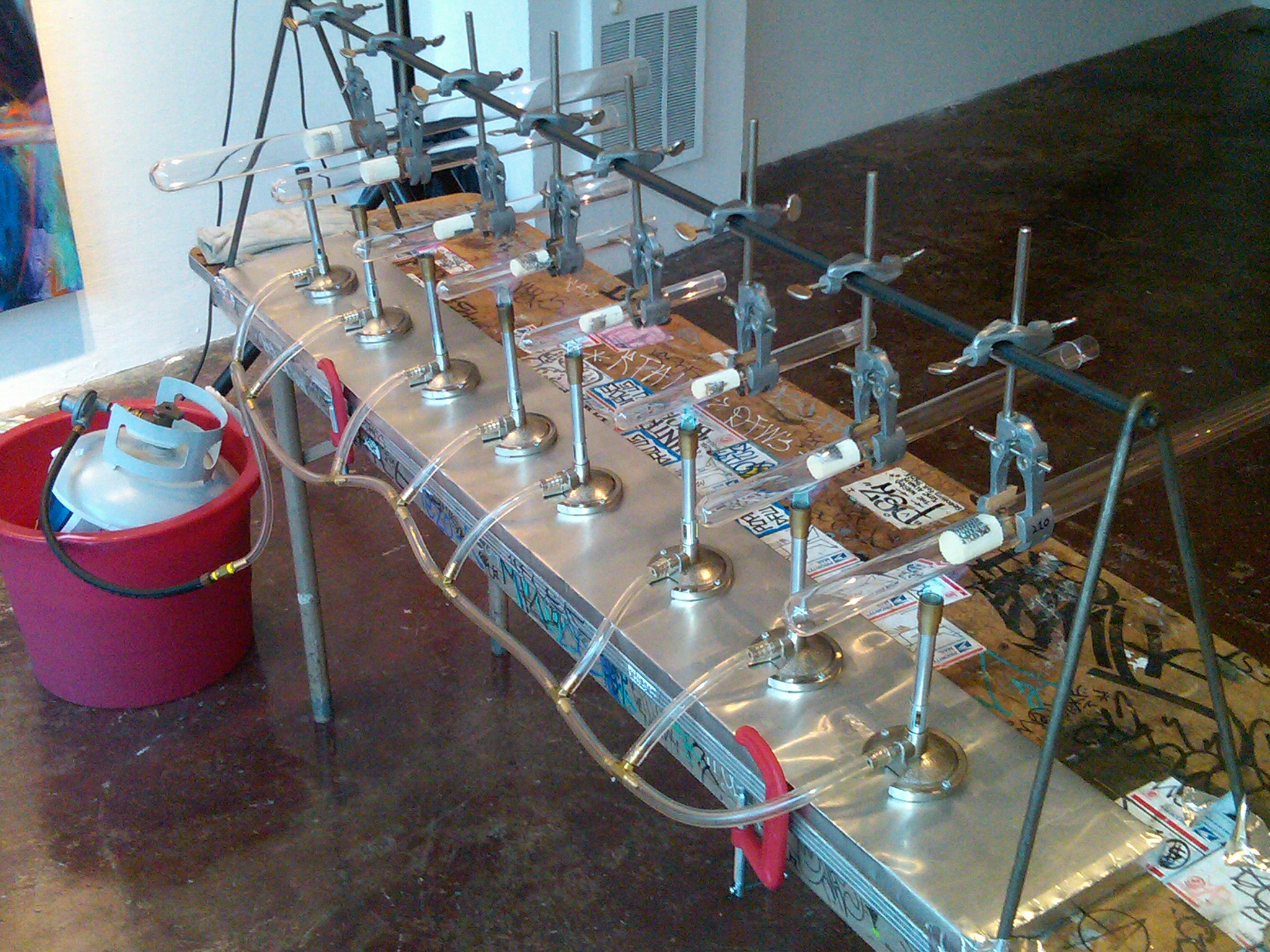
One of the best things about Outsound New Music Summit’s Touch the Gear is that you never know what and whom you’ll find there. For example, it was at a Touch the Gear that I first met collaborator Todd Lerew and saw his amazing flame-activated Quartz Cantabile:

Todd Lerew's Quartz Cantabile

And that was just one of many astonishing inventions and kits…

A bit of a junglee patch...

My “gear” for this year’s Touch the Gear will be virtual and consist purely of software — so if you have a taste for junglee MSP patches — or you want to see some of the most unique music and sound-generating devices and electronic kits that the Bay Area has to offer — come have a look!

I’m very glad that this year we’ll have good representation from the NoiseBridge hackerspace, home of NoiseHacks, circuit-bending, 3D printing, mega TOR-nodes, kombucha, X-Ray lasers, robots, and more.

Partial list of musicians:

— Douglas Benner: custom home-brew modular analog synth environment

Amanda Chaudhary (अमांडा चौधरी): iPad & iPhone instruments

Matt Davignon: CD DJ & Tape Machines

— Bryan Day: Magnetoselqier, Tapewarp 4, & Shuffleboard

— Dr. Martin DeVideo: Electron P-Funk Dynamic Phase Confabulator, Modified Casio SK-5 w patch bay, & 2MD Transvibrating Symphonic MultiWarble

Philip Everett: Processed auto-harp

— Bill Hsu: Audio/Visual Laptop

Ari Lacenski: Superpeggio! & Firefox Synth

— Joe Lasqo: Max/MSP patches/instruments

— Cheryl E. Leonard: Invented acoustic instruments constructed from found natural materials

Fernando López-Lezcano: El Dinosaurio, a homebrew analog synth environment from the Jurassic, newly resuscitated with an external MIDI-controller brain transplant.

Doug Lynner, aka Synthesizerman: “The Mystery Serge,” a 1975 Serge Modular Synthesizer, & some Cyndustries modules

— Bob Marsh: AriSynths & FX pedals

— Tom Nunn: Painted Skatchboxes & a new Crustacean-like Space Plate

— Johny Radio: Sinusoidal oscillators constructed with DC motors

David Samas: Dendrophone, plant rattles, buzz roarer, & bowed rocks

Lindsey Walker: Loops & effects

— Nick Wang: Custom home-brew modular analog synth environment

Address, transit, Outsound New Music Summit schedule, & details: at this web page (scroll down slightly for Touch The Gear)

Look forward to see you there!

Joe

Posted in Uncategorized | Leave a comment

MSP/Piano @Outsound New Music Summit’s “Vibration Hackers” (Thur 25 Jul, @CMC, SF, 8:15 pm)

Vibration Hackers - Outsound New Music Summit, Thu 25 July 2013

I’m greatly honored to have had the opportunity to curate the Vibration Hackers night at this year’s Outsound New Music Summit, an evening which will highlight the deep-space explorations of some of todays most intrepid computer musicians.

We’re going to have everything:

— Wild Twitter-driven son et lumière

— AI vs. AI musicbots

— Exquisitely processed and spatialized depictions of madness and Russian Constructivist aesthetic theories

— Controller craziness which may include Wii-driven sound sculpture, digitized conch shells, advanced daxophonics, and who knows?

You’ll find great info about the music that will be performed, the artists, the venue/address, & transit options at the official festival page (link), so here I’ll offer a few personal thoughts and supplementary images.

Set 1 – 8:15pm: #MAX

#MAX @ The Lab, SF, 15 Dec 2012

#MAX is a composite entity comprised of the web, custom algorithms, and 3 carbon-units: Caitlin Denny, Nicole Ginelli, and Dmitri Svistula (Димитрий Свистула).

I was awed in Dec at The Lab as their amazing Twitter-fed performance created an arena for indiscriminate group genius through the hyperfusion of electronic media.

#MAX @ The Lab, 15 Dec 2012

Setting up an open terminal to be fed hashtags by the audience, #MAX used these inputs from the audience’s spontaneous group mind to probe the web for related audio, text and video, which were subsequently transformed into sound and video art by its custom algorithms and carbon-units — much like the AI inhabiting the high-orbit cores of the Tessier-Ashpool mainframes in William Gibson’s Count Zero constructing Joseph Cornell boxes from the weightless flotsam surrounding it:

#MAX @ The Lab, 15 Dec 2012

“Once, for a brilliant time, time without duration, I was everywhere as well . . . But the bright time broke. The mirror was flawed. Now I am only one . . . But I have my song, and you have heard it. I sing with these things that float around me…”

“Tape Interlude”  – 9pm: Fernando López-Lezcano

Fernando López-Lezcano

Fernando López-Lezcano of Stanford’s CCRMA presents Knock, knock… anybody there?, a short tour de force of sample-rate conversion effects and spatialization techniques that move the listener through a soundscape (or perhaps a soundscape through the listener…), to render visceral the experience of making border crossings between sanity and insanity.

I love to use processed vocal sounds in my own MSP work, so I was all the more intrigued with Fernando’s brilliant use of vocal and conversational samples to create a beautiful musical and emotional trajectory through a crowd of voices that may or may not be interior.

Recently rewritten in a 3rd order full 3D Ambisonics rendering, the piece will be diffused through a CCRMA 8-point sound system.

Fernando López-Lezcano y El Dinosaurio

In addition to being a master of spatialization and the “Scotty” of the Starship CCRMA, Fernando is the proud father of El Dinosaurio, a homebrew analog synth from the Jurassic, newly resuscitated with an external MIDI-controller brain transplant. Don’t miss a chance to experience El Dinosaurio at the Touch The Gear Expo of the Outsound New Music Summit, 7-10pm, Sun 21 Jul (Outsound page: here. My blog post: here)

I had the pleasure to interview Fernando in CCRMA’s spherical Listening Room last week, and the resulting 48 min video interview is above).

Set 2 – 9:20pm: Maxine & Maxxareddu, as channeled by Ritwik Banerji (ঋত্বিক ব্যানার্জী) & Joe Lasqo, with visuals by Warren Stringer

Ritwik Banerji (ঋত্বিক ব্যানার্জী, L) & Rob Frye (R) @ the Ivy Room, 26 Jan 2011

One inspiration for what Ritwik Banerji (ঋত্বিক ব্যানার্জী) of Berkeley’s CNMAT & I are going to do sonically is this video from the Cornell AI lab showing two chatbots kitted out in machinima avatars going at it. I’m sure you’ll agree they have an interesting discussion:

Conversation is perhaps the most universal joint improvisatory activity, and what we hope to do with our musicbot routines is to pursue something similar to what these chatbots do on a linguistic level in the musical sphere.

Joe Lasqo @ Meridian Gallery, 11 Jan 2012 (Photo: PeterBKaars.com, http://www.peterbkaars.com)

I raided a cupboard of techniques ranging from blackboard architectures and, especially, computational grammars, from my old work in expert systems development and natural language processing, to create Maxxareddu.

Improv Grammar Diagram from "The WIsdom of the Impulse", by Tom Nunn

Ritwik brought his own insights into heuristics techniques, machine/human/extraterrestrial learning, and astromusicology to create Maxine.

Ritwik and I will join Maxine and Maxxareddu’s conversation from time to time with our acoustic instruments (sax and piano).

Warren Stringer

It will also be our honor and pleasure to welcome the inimitable visual synthesis of maestro Warren Stringer (of Muse).

Those who have seen Warren at one of my previous shows or a Bay Area technorave know his unique mastery in combining art and algorithm for the real-time visual accompaniment of improvisatory music. (And the rest of you have something great to look forward to.)

L → R: Warren Stringer, Joe Lasqo, and Rent Romus, Luggage Store Gallery, 27 Dec 2012

L → R: Warren Stringer, Joe Lasqo, and Rent Romus, Luggage Store Gallery, 27 Dec 2012

“Tape Interlude” – 9:50pm: Ilya Rostovtsev (Илья Ростовцев)

Ilya Rostovtsev (Илья Ростовцев)

Ilya Rostovtsev (Илья Ростовцев), also of Berkeley’s CNMAT, presents two short movements of his brilliant Understatements suite.

Based on the Russian Constructivist concept of Faktura (фактура) — making visible the qualities inherent in materials —   Ilya’s pieces use an exquisite sensitivity to bind “acousmatic” abstract sounds to processed sounds derived from real-world instruments and soundscapes, to play a subtle game of shifting contextualization and decontextualization.

At once understated and highly dramatic, these pieces all hinge on hidden climaxes of sound transformation from concrete to abstract and back again, for example, revealing an acoustic sound source in an abstract acousmatic field.

Using a brilliant array of techniques to create sonic layers and design not only the sounds, but the virtual spaces for the sounds in the listener’s mind, Ilya will take us through two revealing journeys through soundscapes derived from violin and percussion sounds and their various Klang-Doppelgänger.

After discussing with Ilya the many techniques he used (48 min video interview: above), I’m all the more impressed with how un-evident they are in the resulting pieces, which simply seem like open landscapes filled with beautiful and mysterious living sound entities.

Set 3 – 10:10pm: CCRMA Ensemble (Chris Chafe, John Granzow, Rob Hamilton) + MYSTERY GUEST

Roberto Morales-Manzanares w Rob Hamilton & John Granzow (L→R) of the CCRMA Ensemble @ Transitions 2012 Night 2, September 28, 2012

Roberto Morales-Manzanares w Rob Hamilton & John Granzow (L→R) of the CCRMA Ensemble @ Transitions 2012 Night 2, September 28, 2012

Having heard the intense interplay of these musicians at various CCRMA concerts, especially at the astonishing outdoor Transitions concert last year, I’m very happy to close out the show with dimension-warping improv of the CCRMA Ensemble.

John Granzow (L) and Chris Chafe (R) of the CCRMA Ensemble @ Transitions 2012 Night 2, September 28, 2012

On offer:

— extreme chops on physical instruments ranging from the celletto and guitar to the daxophone.

— drop-dead computer music hackery

— bizarre new ways to use wearable Wii-controllers, digitized conch shells, spatialization and more to create immersive sound environments

— ready, willing, and able to go anywhere in an improv

CCRMA Ensemble are:

Chris Chafe

Chris Chafe at the celletto

Chris Chafe at the celletto

Chris Chafe is a composer, improvisor and cellist, developing much of his music alongside computer-based research.

In moments off from sonifying tomatoes or smog, Chris is also Director of CCRMA.

Recent works include Tomato Quintet for the transLife:media Festival at the National Art Museum of China, Phasor for contrabass, and Sun Shot played by the horns of large ships in the port of St. Johns, Newfoundland. Chris premiered Rocco Di Pietro’s concerto, Finale, for electric cello and orchestra in 2012.

More details on Chris here.

John Granzow, master of mutant bespoke daxophones

John Granzow & Daxophone

Unique daxophone attachments offer many Good Vibrations...

Rob Hamilton

Rob Hamilton performing Resonance Front @ CCRMA, 29 Nov 2012

More details on John and Rob here.

Last, but not least — as if all this weren’t enough — there will be an exciting MYSTERY GUEST.

¿ MYSTERY GUEST ?

This will be a very, very memorable night of vibration hackery…

Look forward to see you there!

Joe

Posted in Uncategorized | Leave a comment

Piano: Braxton’s Ghost Trance Music w Phillip Greenlief & Orchesperry @ Berkeley Arts (Sun 04 Aug, 9pm) + Uncle Braxton (Myles Boisen + John Shiurba, 8pm)

I’m keenly looking forward to joining Orchesperry to perform one of Anthony Braxton’s important Ghost Trance Music works, Composition 255, at 9pm Sun 04 Aug.

The show will be at the East Bay’s indispensable focal point for creative ferment, Berkeley Arts Festival (2133 University Avenue, Berkeley, CA – map).

Phillip Greenlief

We’ll be performing under the leadership of Phillip Greenlief, one of the Bay Area’s greatest explorers of the uniquely Braxtonian mind-meld between the sophisticated, abstract musical structures of post-WW2 classical music and the emotional immediacy and daredevil excitement of the New Jazz, drawing from a full range of improvisatory styles, both “in the tradition” and “non-idiomatic”.

Anthony Braxton

Braxton’s Ghost Trance Music series lays track to interconnect the destinies of two marginalized groups in the struggle for the full decolonization of American culture, while at the same time taking complete advantage of the explosion of musical thinking that started in centers like Darmstadt, Paris and New York after the war.

Cosco Ghost Dance Petroglyphs from Site CA-INY-4836, The Gallery (Death Valley)

From the essay Like A Giant Choo-Choo Train System by Jonathan Piper (liner notes to 9 Compositions [Iridium] &  2006 [Firehouse 12 Records]):

Anthony Braxton (L) & Dave Holland (R)

“…In 1993 Braxton told Graham Lock he was looking for “a system of tracks, like a giant choo-choo train system that will show the connections, so where a soloist is moving along a track, that will connect to duo logics, trio logics, quartet logics. So, for instance, if you’re traveling from Composition 47, which is a small town, to a city like Composition 96, the model will demonstrate the nature of combinations and connections in between systems.”

The Ghost Dance

Things fell into place in 1995 after Braxton sat in on a Native American music course and studied the Ghost Dance rituals of the late 1800s. For Braxton, the Ghost Dance had great resonance. “The Ghost Dance music, when it was put together, that came about in a time after the American Indian had been decimated, 98 percent of their culture destroyed,” Braxton recalls. “Various tribes came together and compiled whatever information they had left. And the Ghost Dance music was described as a curtain—one side is reality for us, and the other side is the ancestors. And the Ghost Dance music would provide a forum to connect with the ancestors. That had a tremendous impact on me.”  Drawing on the example of all night Ghost Dance ceremonies (and other world trance musics), Braxton looked to construct a “melody that doesn’t end” to serve as the train tracks to cohere his system. The Ghost Trance Music was born.”

Anthony Braxton

From the essay by arwulf arwulf, reviewing Ghost Trance Music Composition 338 as performed on 2006 by Quartet (GTM):

Ghost Dance Song (Arapaho)

“Beginning in 1995, Braxton expanded his already unusually vast and complex musical universe by initiating what would evolve into a decade-long series of multi-level improvisatory collaborations which he called Ghost Trance Music. The “first species” of this special type of “continuous state music” was patterned after indigenous North American drumming and inspired by the Ghost Dance Rituals of the Plains Tribes as practiced during the late 19th century. It was also informed by the Indonesian shadow puppet theater tradition. Like the rituals for which it was named, Ghost Trance Music materialized initially as an intuitive system for ancestor reverence and collective memory.

Anthony Braxton

Specifically, Braxton sought to honor and invoke a veritable composite Ghost of the Old Masters…. Braxton’s collage technique, which first came to full fruition with his Quartet during the ’80s, coexists in Ghost Trance Music with elemental language music coordinates which date back to his earliest compositions. As the series evolved, Ghost Trance Music became increasingly non-linear, while what Braxton calls the Ritual Function became more important than ever. Contained only by duration, these works (which are more like sets of coordinates than composed entities) really have no beginning and no end.”

Anthony Braxton's Compositions 255 & 265, with graphical layouts showing locomotives

Composition 255 is one of the “second species” of Ghost Trance Music, which Braxton launched in 1998, breaking up the rhythmic stream with interruptions and increasingly complex rhythmic subdivisions, and was premiered with Chris Jones in New Mexico in 2003.

Phillip Greenlief solos w Orchesperry @ the In The Flow Festival, 19 May 2013

Phillip Greenlief and Orchesperry recently performed Composition 255 to high acclaim in the Sacramento In The Flow festival, and I join them in presenting this experience to the Bay Area audience with great pleasure.

Reviewing the In The Flow performance, Craig Matsumoto said: “If you’re not familiar with Ghost Trance Music, it’s based on a maddening, non-steady pulse that, on the surface, can seem like the musical equivalent of a guy reciting π. But… when you’ve got a large group of friends performing, it almost develops a party atmosphere.”

Gino Robair conducts Orchesperry @ the Luggage Store Gallery, 03 Jun 2009

Orchesperry is part of the continuing impact of the late, great bassist Matthew Sperry on Bay Area musical culture and beyond.

The line up for our 13tet performance of Composition 255 is:

Joel Bremson

Joel Bremson – bass

Keith Cary

Keith Cary – cello

Luis Albert Clifford Childers

Luis Albert Clifford Childers (Facebook link) – trombone, euphonium, chromatic harmonica

Dax Compise w Ghiadub Trio @ Old Soul, Sacramento, 27 May 2013

Dax Compise – percussion

Tara Flandreau

Tara Flandreau – violin

Michael Frost

Michael Frost – viola

Phillip Greenlief – conduction, alto saxophone

Joe Lasqo @ Meridian Gallery, 11 Jan 2012 (Photo: PeterBKaars.com, http://www.peterbkaars.com)

Joe Lasqo – piano

Christina Maradik-Symkowick

Christina Maradik-Symkowick – viola

Tim Onorato w Ghiadub Trio @ Old Soul, Sacramento, 27 May 2013

Tim Onorato – electric bass

Tony Passarell

Tony Passarell – tenor saxophone

Amy Reed (w the purple hands of Phillip Greenlief...)

Amy Reed – electric guitar

Suzanne Thorpe

special guest: Suzanne Thorpe, flute, processing, laptop

Phillip Greenlief performs at the Vexations [Re-vex’d] 22-hour improv marathon at Berkeley Arts on 24 Mar 2013 (photo: Joel Deuter)

Orchesperry’s leader in the performance is saxophonist and composer Phillip Greenlief, the founder of Evander Music; an independent record label presenting original composition, improvised music and jazz. Since 1986, his recordings and performances have received critical acclaim in Down Beat, All About Jazz, Jazz Times, Cadence, Modern Saxophone, InfraTunes (France), Altrisuoni (Italy), The Wire (London), Colossus (Finland), St. Petersburg Times (Russia), Cuademos de Jazz (Spain), New Jazz Improv (Portugal), Los Angeles Times, etc. His duo recordings of improvised music with bassist Trevor Dunn and drummer Scott Amendola received 5 stars in the Music Hound Jazz Essential Album Guide. Recordings with The Lost Trio and his compositions on Russian Notebooks were listed on the Critics’ Top 10 Lists of the SF Chronicle, San Jose Mercury News, East Bay Express, & Downtown Music Guide (NYC). Phillip is a recipient of the San Francisco Bay Guardian Goldie Award and has recently completed a 2013 composer residency at the Marin Headlands Center for the Arts.

Phillip began playing guitar and trumpet in elementary school and explored various instruments before discovering the sax in the mid-1970’s. His ever-evolving relationship with the sax continues to unfold with an expansive sound vocabulary, extreme dynamic range, a deep regard for melody and form, and a humor and wit that echoes the Native American Coyote tales. As a composer, he has created nearly 300 works for almost every conceivable ensemble, including numerous pieces for solo sax, sax + string quartets, jazz ensembles, chamber groups, electro-acoustic improvisers, film projects, live theater, works for large ensemble & orchestra + choir. As an organizer, he has produced concerts for local musicians and internationally touring artists under the auspices of Evander Music Presents since 1997, and is currently serving as curator at Berkeley Arts Festival.

Phillip has performed internationally in a variety of settings since 1982. In addition to club dates and concert tours across North America & Europe, he’s performed at the John Coltrane Festival in Los Angeles, Seattle Improvised Music Festival; Freiburg Zelt Muzik Festival; Big Sur Sound Shift; Olympia Experimental Music Festival; Du Maurier Jazz Festival; the WIM in Zurich; the Ulrichsburg Festival and the Konfrontation Festival in Nickelsdorf, Austria; the Isole Che Parlano Festival in Sardinia and the Venice Biennale; and the International Festival of Arts in Sao Paulo. In 1998 he lived in St. Petersburg (Russia) where in addition to playing solo he performed and recorded with several jazz groups, singer-songwriter Yelena Kolokolnikova (Елена Колокольникова), and the Russian folk ensemble Dubinushka (Дубинушка).

Phillip Greenlief's brilliant CD, Lines Combined

A man with many musical friends, Phillip’s list of collaborators takes up 25 single-spaced lines, and rather than list them here, I’ll instead urge you to get his brilliant recent solo album, Lines Combined, a series of intense pieces inspired by the art works of Eva Hesse and Robert Rauschenberg that perfectly illustrates the Braxtonian mind/body fusion and reads like the sax version of Dubliners.

Beginning the show at 8pm in Set 1 will be Uncle Braxton, a duo project of guitarists Myles Boisen and John Shiurba that has grown over nearly 20 years.

Myles Boisen

Myles Boisen’s vibrant stream of explorations in music, audio engineering and photography have made him a pillar of the Bay Area cultural scene.

Often sensed before he is seen — by the telltale scent of 13♯9 chords, earth after rainfall, and Martian wisteria — Myles is a recording and mastering engineer, album producer, film and television composer, journalist, guitarist and bassist.

Myles Boisen (Photo by Michael Zelner)

His résumé includes hundreds of studio and live recordings for independent groups and labels, as well as for MTV/Comedy Central, CBS, Warner Bros., Polydor, PBS, et. al.

Myles was the engineer on The Gorey End CD by The Tiger Lillies and Kronos Quartet (EMI Classics), nominated for a Grammy award in 2004. His production and restoration work on Clarence “Guitar” Sims’ Born To Sing The Blues CD (Mt. Top Records) garnered two awards from Real Blues Magazine in 1999: “Best West Coast blues reissue” and “Best studio sound technique”.

Myles Boisen (Photo by Michael Zelner)

In addition to musical performances with Tom Waits, John Zorn, the Rova Saxophone Quartet, Fred Frith, Eugene Chadbourne, Splatter Trio, and The Club Foot Orchestra, Myles has contributed to a number of independent film soundtracks, plus director David Lynch‘s films Twin Peaks and Wild At Heart.

Throughout the 1990′s Myles was a composer and bassist in The Club Foot Orchestra, which is generally acknowledged as the first national touring ensemble to revive the art of original music performance with classic silent films and cartoons. During this period the CFO collective appeared at Lincoln Center (New York City) and Disney World (Orlando, FL) performing their scores for such vintage classics as Fritz Lang’s Metropolis, Pandora’s Box, and Buster Keaton’s Sherlock Jr.

The softer side of Myles Boisen (Photo: Joel Deuter)

As a composer, Myles has scored original work for the award-winning Onsite Dance Co (ODC; San Francisco/New York), Rova Saxophone Quartet, and numerous Bay Area new music ensembles. He’s currently the music director of Orchestra Nostalgico, a CFO spinoff dedicated to the live performance of film music (Nino Rota, Ennio Morricone, John Barry). Myles pursues his musical interests in Oakland, where he’s the chief engineer at Guerrilla Recording, a full service recording studio.

John Shiurba

John Shiurba is a composer and guitarist whose musical pursuits include improvisation, art-rock, modern composition and noise. John has recorded and toured the U.S. and Europe as a member of the bands Eskimo, The Molecules and Spezza Rotto, as a member of the Merce Cunningham Dance Company and the sfSound ensemble, and in various improv settings. John has composed works for his own Triplicate and 5×5 ensembles, for the sfSound Ensemble, and for various soloists. As a guitarist John has developed a unique and personalized approach to the guitar. Through the use of extended techniques and unusual preparations, he expands the traditional sound range of the instrument, producing stunning, often unrecognizable results.

John Shiurba

Cadence Magazine calls John Shiurba a “wildly creative guitarist… anti-jazz, anti everything else, yet utterly compelling.” John was invited to play at the Seattle Improvised Music Festival, the High Zero Festival in Baltimore, and the Olympia Experimental Music Festival, as well as being featured at New Langton Arts in 2002, premiering his work Triplicate. He’s played with internationally acclaimed musicians such as Anthony Braxton, Fred Frith, Eugene Chadbourne and Jack Wright, as well as many of the finest West Coast improvisers — Gino Robair, Dan Plonsey, Scott Rosenberg, Myles Boisen, Matt Ingalls, Tim Perkis, and Matthew Sperry to name a few.

John Shiurba (L) & Kjell Nordeson (R), photo by Dill Pixels

John Shiurba (L) & Kjell Nordeson (R), photo by Dill Pixels

In 1998 John formed the improvised music label lIMItEd SEdItION, which has released 28 CDs documenting the diverse and lively Bay Area improvised music scene.

Braxton, Orchesperry, Greenlief, Boisen, Shiurba — your ears can’t afford to miss this unique evening…

See you there!

Joe

Posted in Uncategorized | Leave a comment

Guest sets – Double Shak Attack w Cornelius Shinzen (深禅) Boots & Karl Young @Viracocha, SF (Wed 12 June, 4pm & 5pm)

Viracocha

I’m honored to host two of the Bay Area’s most talented shakuhachi players, Cornelius Shinzen (深禅) Boots and Karl Young, for two special acoustic sets at 4pm and 5pm, Wed 12 June during my regular booking at Viracocha (NW corner of 21st & Valencia, San Francisco).

Long-time disciples under masters of the traditional Japanese honkyoku (本曲) repertoire, Karl & Cornelius have also taken the shakuhachi into explorations beyond its usual space with unique élan, ranging the gamut from “heavy chamber” covers of Black Sabbath to unique Asian takes on jazz classics, while keeping musical company with virtuosi of trad-shak like Michael Chikuzen (竹禅) Gould and Riley Lee.

Karl Young (L) & Cornelius Shinzen (深禅) Boots (R), as members of the shakuhachi section for Undercover Presents' re-mix concert of Black Sabbath's "Paranoid", 19 May 2012

Cornelius Shinzen (深禅) Boots (L), Philip Gelb, and Karl Young (R)

Cornelius Shinzen (深禅) Boots (L), Philip Gelb, and Karl Young (R)

Cornelius is bringing a special mix which including honyoku classics like:

— Shika No Tōne (The Distant Call Of The Deer, 鹿の遠音, duet with Karl Young)

— Fūrin (Wind Forest, 風林, on the 2.4 shakuhachi)

Half Of The Beast, an original mukyoku (無曲) piece for the 2.8 taimu (大無) flute, in the spirit of the classic Kyorei (Empty Bell, 虛鈴)

— The Hills, renegade nature music “duology” (arrangements for the 1.8 shakuhachi of 2 classic rock tunes with “Hills” in the title:

> Run to the Hills (Iron Maiden)

> Over the Hills And Far Away (Led Zeppelin)

Cornelius Boots playing shakuhachi (尺八)

“The Rod Serling of chamber music composition, the David Lynch of the bass clarinet, and the Luke Skywalker of the bamboo flute.”

East Bay reed renegade Cornelius Boots is a progressive rock & “heavy chamber music” composer, bass clarinet virtuoso, wu wei woodwind instructor & Zen flute adept. He is a dabbler in Tibetan mysticism and Taoist wizardry, & a devotee of the Respirational Arts.

Cornelius Boots playing taimu shakuhachi (大無尺八)

Recent projects include the composing, calligraphic notation and recording of a series of 27 études (mukyoku, 無曲) for taimu shakuhachi (大無尺八, large Zen bamboo flute), performances and recordings with the elemental sound-structuring ensemble, Sabbaticus Rex (taimu shakuhachi, throat singing, large overtone gongs), and the collaborative composing of an avant-orchestral rock opera, An American Faust.

Cornelius Shinzen (深禅) Boots & Karen Stackpole performing as Sabbaticus Rex (not pictured- Mark Deutsch)

Since 1996 he has led and written virtuosic “heavy chamber music” for Edmund Welles, the world’s only original bass clarinet quartet, with whom he’s released 3 albums: Imagination Lost, Tooth & Claw, and Agrippa’s 3 Books. The quartet had featured recitals at Clarinetfest and Switchboard Music Festival, received a Chamber Music America New Works grant, and has shared the stage with Medeski, Martin and Wood, Sleepytime Gorilla Museum, and Extra Action Marching Band.

In addition to receiving a Jun Shihan (準師範) ranking from shakuhachi Grandmaster Michael Chikuzen (竹禅) Gould, he has music degrees from Indiana University (BM Clarinet Performance, BS Audio Recording, MM Jazz Studies) where he studied with Howard Klug, David Baker, Alfred Prinz, David Pickett and Wayne Jackson.

Karl Young

I’m also very much looking forward to duet with Karl Young.

In addition to the solo honkyoku (本曲) piece Sagari-Ha (Falling Leaves, 下り葉) by Karl, Karl and I will do special shakuhachi+piano duets, including pieces such as:

Ornette Coleman

Lonely Woman, by Ornette Coleman

Cover of Joe Lasqo's Album "Turquoise Sessions", available 18 Oct 2011from Edgetone RecordsChōshi (調子), after the Neo-Gaku arrangement on my album, Turquoise Sessions.

Steve Adams

#39, by Bay Area saxophonist Steve Adams of ROVA Saxophone Quartet

Bishu Chatterjee (বিষু চ্যাটার্জি)

— Nile Shobuj (Green in Blue, নীলে সবুজ) by Bay Area bassist Bishu Chatterjee (বিশু চ্যাটার্জি)

Larry Ochs & friend

Failure, by Bay Area saxophonist Larry Ochs of ROVA Saxophone Quartet

— and other surprising pieces for shakuhachi (like Eleanor Rigby, Miles’s Davis’ So What, etc.…)

Murasaki Ensemble (紫アンサンブル) - Karl Young above bass

After an initial period as a jazz tenor saxophonist, Karl Young embarked on a career as a physicist and entered an intensive study of the shakuhachi. Over the past 20 years he has studied with a number of teachers; his primary sensei are Kaoru Kakizakai (柿堺香) and Riley Lee, both masters in the dokyoku (道曲) tradition, and students of Katsuya Yokoyama (横山勝也).

While his focus has been on the traditional solo honkyoku repertoire in the dokyoku tradition he also plays sankyoku (三曲) or traditional ensemble music with shamisen & koto, as well as min’yō (民謡) or Japanese folk music. He is co-founder of the group Ensohza (縁囃座), specializing in traditional minyo and Japanese folk dance, in which he plays the shinobue (篠笛) or transverse bamboo flute in addition to the shakuhachi. He also participates in the East-West Murasaki Ensemble (紫アンサンブル), led by Shirley Kazuyo Muramoto (村本和世).

He couldn’t help wandering back to his roots and recently worked with jazz flutist Ali Ryerson on developing an approach to jazz shakuhachi. He subsequently released Lost In The Wood, a CD of jazz standards and original pieces in an exploration of the expressive possibilities for shakuhachi in jazz. He has recently been playing jazz in various ensemble formats around the San Francisco Bay and “Mendonoma” areas.

Karl Young's recent jazz shakuhachi CD - Lost In The Wood (I guarantee you've never heard a version of Polkadots & Moonbeams like this...)

Viracocha is a unique polyvalent zone spread over several levels at the NW corner of 21st & Valencia, San Francisco, that functions as post-modern antique shop, piano lounge / performance space, lending library, gallery, and all-purpose cultural node. It has been my pleasure and honor to play there weekly for the last 2¾ years. (Here’s a lovely article on Viracocha with a picture of me playing from the back).

Joe Lasqo @ Meridian Gallery, 11 Jan 2012 (Photo: PeterBKaars.com, http://www.peterbkaars.com)

Warmly hope to see you at this special show!

Joe

Posted in Uncategorized | Leave a comment

MSP/Piano: Cage’s Two² w Patti Deuter, MSP/piano auto-duets, & meta-rāgas (Sun 23 June, Fête-Concert, @ Le Piano Studio, Russian Hill, SF)

Eliane Lust performs "Chronicle of a Piano Woman", Paris

Internationally renowned concert pianist Eliane Lust was raised in Belgium and has performed to critical acclaim on the world’s most prestigious concert stages from Paris to New York.

Those who have been fortunate enough to hear her can attest to her amazing ability to melt into the piano and control it from the inside.

Le Piano Studio

Her Le Piano Studio is the elegant epicenter of her rehearsal and teaching activities, and the site of a glorious Fête-Concert on Sun 23 June.

Following on to playing Cage in the last 2 Fêtes-Concert, I’m very excited to rejoin a party of some of the most fascinating pianists in the Bay Area who will together present an exciting and eclectic program ranging from classical to avant-garde, and spanning continents from Europe to Persia, India, and Japan (plus definitely… more Cage!)

John Cage at the piano

The event will start around 6:30pm and end around 11pm, during which many of the works will be repeated between bouts of food, laughter and good company.

The Fête-Concert is a private rather than public affair, but I can wrangle some invitations to this unique event.

If you’d like to come, please contact me at joe@joelasqo.com as soon as possible, and I’ll see what I can do to get you in and let you know more details.

Patti Deuter performs Cage's "Four Walls" @ Berkeley Arts Festival

My partner in crime for the two-piano/two-pianist piece Two² by Cage will be the delightful and brilliant pianist Patti Deuter, organizer and ringleader of the last September’s Satie/Cage Vexations at Berkeley Arts.

Patti Deuter (left, at toy piano): "Violette Nozieres, Revenant". (Performance-Installation with toy piano & projection of Surrealist Book; Patti Deuter & Anna Wexler @ Pierre Menard Gallery, Cambridge, MA, 2009) Photo: ©Jane Wang

Often found in Paris as well as California, and a student of Eliane Lust’s, Patti is an indefatigable macherin of the new music and piano scenes of the Bay Area. From her studio-cottage nestled in the trees, where everything is keyed to one of four vibrant synesthetic colors (forming, I would say, a visual rootless 13th chord in second inversion… Scriabin would approve), passionate strains of Rzewski, Cage, Wolff, and other masters of 20th and 21st century piano escape to infuse the air.

John Cage and D.T. Suzuki (鈴木 大拙 貞太郎)

As is well known, John Cage was heavily influenced by Zen Buddhism and Japanese culture in general, and the piece we’ll perform, Two², is his remarkable musical re-imagining of the fascinating traditional Japanese linked-verse form, renga (連歌).

With beginnings in the time of the Man’yōshū (万葉集), c. 760 A.D., renga evolved into a very sophisticated game played by connoisseurs who used its 5-line stanzas consisting of a 5-7-5 syllable haiku (俳句) + a 7-7 syllable response in an interplay of group-improvised linked-verse, exchanged among the members of a (usually saké-soaked) poetry party (not unlike the similar game of cadavre exquis played in graphical form by the Paris surrealists).

Renga paper of poet Nishiyama Sōin (西山宗因連歌懐紙)

Japanese poetry fiends took renga to remarkable heights of sophistication, defining an elaborate aesthetic of seasonal symbolism, pivot-stanzas referring to moon and cherry blossoms, and special gold-and-silver dusted papers of different shapes, sizes and colors, corresponding to distinct parts of the symbolic program, to brush their poems onto whilst sipping from cups of saké brought to them sushi-boat-style by special garden streams constructed for this purpose.

John Cage performs "Water Walk" on "I've Got A Secret"

Cage’s luminous and serene Two² for 2 pianists uses the 36-stanza kasen (歌仙) form of renga, re-imagining each of the 5-line stanzas as 5-measure musical units, each filled with 5 or 7 piano sound-events which replace the syllables of the original poetic form.

Say hello to my little friend...

Like many of the other Cage “number pieces”, the timing of the musical events in Two² is not strictly determined, but unlike the “time bracket” approach to indeterminacy found in many of the number pieces, here instead Cage sets up a marvelous game of simple rules to let the two pianists create an interlinked joint control of fluid time, a game in which they can support or subvert each other, creating meditative kaleidoscopic ripples of piano sound which will be uniquely different in each performance.

Similar to Western classical music forms having 3 movements, renga-sequences employ 3 sections, called Jō-ha-kyū ().

While Patti and I will do the full hour+ version of Two² in a concert setting later in 2013, for this event, we’ll do stanzas 7-18 of the ha “movement”, including one of the three “moon stanzas” and one of the two “flower stanzas” of the kasen form. (In Eliane’s last Fêtes, we did the final and first movements, so naturally here we continue with the middle…)

Modern Renga Banquet at the Shusuitei in the Kyoto Imperial Park (連歌の会席〜京都御苑内の拾翠亭にて)

Modern Renga Banquet at the Shusuitei in the Kyoto Imperial Park (連歌の会席〜京都御苑内の拾翠亭にて)

And we will honor the tradition of alcohol-assisted creativity, as we’ll be marking the end of each stanza with ceremonial libations (which may lead to some interesting musical results as we repeat performances during the event…).

Some of the most exciting pianists in the Bay Area will be joining us. A full list is not in hand, but here are some of the pianists who will perform:

Luciano Chessa performing Joan La Barbara's "Hear What I Feel" @ Pamela Z's VOICECAGE, 21 Aug 2012

Luciano Chessa: 3 pieces by 2 Argentine composers – Miguel Galperin: El preludio como Eco, + Federico Salesi: Tucuman 2032 and Novembre-Dicembre ’84.

Frank Clare

Frank ClareOriginal compositions and improvisations

Patti Deuter (solo) – Satie: Gnossienne 4, Morton Feldman: Piano Piece (1952)

Lynea Diaz-Hagan

Lynea Diaz-Hagan (special guest vocalist) – Duets with Ramin Zoufonoun (رامین ذوفنون), see below.

Trained from a young age as classical vocalist, Lynea made the transition to jazz after several years of vocal exploration and experimentation in New York, where she was influenced by the avant-garde jazz scene.

Her influences range from jazz greats Sarah Vaughan, Ella Fitzgerald and Betty Carter, to the hard-edged Betty Davis and Gal Costa, to contemporary vocal pioneers Bobby McFerrin, Iva Bittová, Meredith Monk, and Sussan Deyhim (سوسن دیهیم).

.

David Hatt

David Hatt

David Hatt — Marcel Dupré: Prelude in F Minor & works by Cornelius Heinrich Dretzel

Jim Jowdy
Jim JowdyFugue from Brahms-Handel Variations, Op. 24

Joe Lasqo @ Meridian Gallery, 11 Jan 2012 (Photo: PeterBKaars.com, http://www.peterbkaars.com)

Joe Lasqo – Original MSP/piano electroacoustic and Indo-modernist pieces:

— Auto-duets, laptop & piano

The Saturnian meta-rāga Śani-Haṭakaṅgi (शनि-हटकङी).

These electroacoustic auto-duets are often based on extended meta-rāgas incorporating timbal as well as pitch-based melodies, and employ a variety of signal-processing and AI techniques for direct electronic synthesis as well as the processing of diverse sound sources such as space probes, manipulated vowel formants, crowds and animals, etc.

Formants - Hot, Hat, Hit, Head

Also, an Indian classical piece adapted for the piano:

Tyāgarāja (త్యాగరాజు)

— Brochevārevarurā by Tyāgarāja (Rāga: Śrīranjani) [త్యాగరాజు: ப்ரோசே வாரவெருரா (ராகம்: ஸ்ரீ ரஞ்ஜனி, தாளம்: ஆதி)]

(Tyāgarāja, 1767–1847, was a member of the South Indian “Trinity” of composers, contemporaneous with Haydn-Mozart-Beethoven and occupying a similar position in S. Indian music history.)

Roger Rohrbach at the piano

Roger Rohrbach at the piano

Roger Rohrbach — Toru Takemitsu (武満徹), Litany I. Adagio & II. Lento misterioso, 1989

Melissa Smith

Melissa Smith J.S. Bach: Toccata in E minor

Kelly Walker at the piano
Kelly Walker Corigliano: Fantasia on an Ostinato, 1985

Ramin Zoufonoun (رامین ذوفنون)

— Persian classical music adapted for piano and duets with Lynea Diaz-Hagan (see above), with whom he’ll perform selections from his suite « بيداد‎ » (Bidad, “Injustice”).

I must call a bit of attention to Ramin’s pioneering and inspiring work in adapting the unique modes (dastgāh (دستگاه‎)), motivic inventories (radīf (ردیف)), and microtonal tunings of Perisan music to the piano.

It has been fascinating to compare notes with him in our respective journeys in the encounter between perhaps the most Western of instruments and aspects of Asian and Middle Eastern music which fall between the cracks of the piano keys.

Ramin Zoufonoun (رامین ذوفنون) with tools for Persian-tuning a piano

In this endeavor, Ramin has become adept at retuning pianos to accommodate the super-flat thirds and other microtonal intervals of Persian music.

Getting In Tune by Ramin Zoufonoun (رامین ذوفنون)

The wonderful results can be heard on his album, Getting In Tune.

Eliane Lust at Old First Church, San Francisco (Photo credit: Panithi Damrongkul)

The highlight of the Fête-Concert will no doubt be the brilliantly intimate sound of Eliane Lust, who’ll play selections from her brilliant Hot New Tangos program and/or Chopin. Those who heard the premier of this program at Old Saint Mary’s in November will attest to it’s vivid freshness and virtuosity.

Eliane’s innovative programming and adventurous musicianship have garnered her award recognition from the California Art Council and invitations as the featured piano soloist in several multi-media productions. Her uncommon piano repertoire ranges from classical masterpieces to brand new works being written for her by today’s leading contemporary composers. As concert curator Eliane has also created groundbreaking musical events such as the “O Solo Milhaud” 100th Anniversary Piano Marathon, to the Musicalliance Concert Series, to Mozart Madness, simultaneously presenting her dynamic master classes, lecture-recitals and clinics throughout the United States, Europe and French Polynesia.

Eliane has participated in the Aspen, Banff, Ernen, Montalvo, Spoleto and Tanglewood Music Festivals and performed at Carnegie Recital Hall, the Paderewski Festival, Chateau LaGesse, the Dame Myra Hesse Series, Musiconcerts, the Legion of Honor, Les Journées de Périgueux, and others. She’s appeared as soloist with the NJ Philharmonic, the Schubert Society of New York, Boston’s Orchestra & Chorale Society, the Diablo Symphony & the New England Contemporary Ensemble, among others. Her chamber music collaborations include performances with such luminaries as Anner Bylsma, Walter Trampler, Ron Leonard, Aurèle Nicolet and Frederic Rzewski.

A graduate of the New England Conservatory of Music in Boston, Eliane’s musical roots lead directly to the historic pedagogies of both Beethoven and Liszt through her close studies with legendary pianists György Sebök and Leonard Shure. Other important influences include American pianists Richard Goode, Claude Frank, Aube Tzerko, Leon Fleisher, Joseph Kalichstein, Menahem Pressler and chamber coaches Yo-Yo Ma (馬友友), Gilbert Kalish, Eugene Lehner (Léner Jenő) and Louis Krasner (Луис Краснер). A notoriously inspiring coach, Eliane maintains an active master class studio for highly dedicated musicians and performers in San Francisco, California. More information at elianelust.com.

Join us for a unique gathering of musical friends at this Fête-Concert by contacting me at joe@joelasqo.com as soon as possible for one of a limited number of invitations.

じゃまたね。。。

Joe

Posted in Uncategorized | Leave a comment

MSP/Piano: w Donald Robinson @ Berkeley Arts (Wed 26 Jun, 8pm) + Tango № 9 (9pm – when else…?)

After a series of private performances at the musical rituals of the secret society IBIM, Don Robinson and I are presenting the initial findings of our paranormal researches into rhythm at 8pm Wed 26 Jun, 2013 at Berkeley Arts Festival (2133 University Avenue, Berkeley, CA).

It’s a great pleasure for both of us to once again play at the East Bay’s essential hub for new and creative music, a venue that’s delivered an amazing stream of cutting-edge music to the Bay Area community — especially in this very hot double bill with Tango 9 (Set 2, 9pm).

Don Robinson performing w the Kris Tiner Trio @ In The Flow Festival, Sacramento, 14 May 2012 (photo by George Thomson)

Don Robinson performing w the Kris Tiner Trio @ In The Flow Festival, Sacramento, 14 May 2012 (photo by George Thomson)

Described by Coda as a “percussive dervish”, Don Robinson is a technical master of the drums. He is a stalwart of the of San Francisco Bay Area avant-garde jazz scene, playing and recording with many of the area’spast and current improvisational players, from saxophonists John Tchicai, Marco Eneidi and Larry Ochs to koto player Miya Masaoka (正岡みや) and pianist Matthew Goodheart, and with prominent visitors like Cecil Taylor, Wadada Leo Smith, George Lewis, trumpeter Raphé Malik and Canadian pianist Paul Plimley. Much of this work has featured the combination of Robinson and bassist Lisle Ellis as rhythm section: ‘the best bass-drums tag team on the scene’ (Jazz Times). His longest musical association, dating from the 1970’s, was with the late tenor saxophonist Glenn Spearmann.

Don Robinson (up), Fred Frith (down), & Larry Ochs (L) @ Starline Social Club, 31 Aug 2012

Born in Boston, Massachusetts in 1953, Don first studied classical percussion at the New England Conservatory. During the early 1970’s he served his musical apprenticeship in the jazz world of Paris, studying with Kenny Clarke and playing with Alan Silva, Anthony Braxton, Oliver Lake and Bobby Few among many others. He first played with Spearmann as a duet partner during this period in Paris, an association which continued through various configurations and many recordings until the saxophonist’s death in 1998.

Don Robinson (L) & Larry Ochs (R)

Fresh from a European tour with Larry Ochs of ROVA Saxophone Quartet, Don will be joined by myself on laptop & piano.

Don Robinson & Biggi Vinkeloe perform @ Eld Records / Studio Fabriken, Göteborg, Sweden

In working with Don, I’ve reached back into my percussion studies in South India as a performer on the mṛdangam (மிருதங்கம்) & into the stochastic rhythm theories of Xenakis, projecting these rhythmic structures through the prisms of signal flow code & keyboard — my drum kit has hammers, strings & recursive filters.

Vidwan V. Nagabhushanachar (V. ನಾಗಭೂಷಣಚಾರ್, L) & Joe Lasqo (R)

Position for strokes NAM and DHIM on the mṛdangam (மிருதங்கம்)

Klangfarben - Einfluss der Grundströmung auf den Klang der Blockflöte

Together, Don and I open a sophisticated new space of interlocking rhythmic energy, distressed tālas, and unexpected re-mappings.

Free jazz, Indian, or electronic?

Rhythmelodics or „Klangfarben-Hoquetus“?

Whatever you decide it is, you’ll not have heard anything like it before…

Tango № 9 (Photo by Kat Nyberg)

Set 2: Tango № 9 (9pm)

Catharine Clune – violin
Zoltan DiBartolo – voice
Joshua Raoul Brody – piano
Greg Stephens – trombone
special guest: Isabel Douglass – accordion

Presenting music old and new, Tango 9 embarks on a fascinating musical adventure, borrowing from the rich tango tapestry, beginning with Astor Piazzolla and then adding a touch of Kurt Weill, a dash of humor and a pinch of West Coast modernism.

Tango № 9 (Photo by Kat Nyberg)

Tango 9, born in the Mission District in 1988, began by exploring where Piazzolla and jazz met. Today, it has become an all-star Bay Area ensemble, recognizable by its unique instrumentation of violin, trombone, piano, and voice. The group delves deeply into the world of tango, recording 4 critically acclaimed albums, presenting numerous concerts and is constantly exploring different facets of the tango.

If you don’t know their music, I would warmly recommend any of the following brilliant albums (if you do know their music, you’ll be coming to this show….):

— Live at the Columbarium

Here Live No Fish

Radio Valencia

— All Them Cats in Recoleta

All of the musicians in this marvelous group are superb, but as a pianist, my mouth never fails to drop open at the dizzying command of ALL 20th-C piano styles on the part of Joshua Raoul Brody (also an early member of the infamous Club Foot Orchestra).

Join us for an energizing evening that will leave your ears much wider…

Hope to see you there!

Joe

Posted in Uncategorized | Leave a comment

MSP/Piano: Post-jazz compositions for improvisers w Aaron Bennett’s Electro-Magnetic Trans-Personal Orchestra @ Berkeley Arts (Wed 15 May, 9pm) + Myles Boisen’s Ornettology (8pm)

Aaron Bennett’s phenomenal post-jazz ensemble Electro-Magnetic Trans-Personal Orchestra returns to the East Bay at 9pm, Wed 15 May at Berkeley Arts Festival (2133 University Avenue, Berkeley, CA – map).

It’s a great pleasure to once again play at the East Bay’s essential hub for new and creative music, a venue that’s delivered an amazing stream of cutting-edge music to the Bay Area community — especially in this very hot double bill of post-modern jazz & post-jazz modernism with Myles Boisen’s Ornettology (Set 1, 8pm).

If you’ve already heard the first album of Aaron Bennett’s unique compositions released by Electro-Magnetic Trans-Personal Orchestra (cover below),  you’re already coming to this great show. If not, run, don’t walk, to get a copy at http://emtpo.bandcamp.com/ and hear what the fuss is about.

Electro-Magnetic Trans-Personal Orchestra (cover art: Nancy Bennett)

Among Aaron’s many stellar contributions to the Bay Area improv and new music scenes (like sax trio arrangements of Bollywood standards) are fantastic “breathing chart” compositions for large improvising groups that deliver heightened coherence and adventure at the same time. They stand as Himalayas of group improv music. And Electro-Magnetic Trans-Personal Orchestra is the Mt. Everest.

Vapor Trails of Structure in Electro-Magnetic Trans-Personal Improv...

To quote Aaron: “The members of this ensemble utilize the electro-magnetic field of their collective mind to attain a unitive transcendent state of sonic consciousness and in turn, create sublime and/or unusually expanded sonic experiences for their listeners.”

The electro-magnetic field is tuned and amplified by means of unique “breathing chart” compositions using a special graphic notation Aaron has designed for large improvising ensembles to focus and unleash aural energies. The resulting sound is like nothing else and has amazed audiences in a string of orgone-accelerating Bay Area performances over the last year.

(For a more detailed interview with Aaron about this music, please check out Craig Matsumoto’s post: Aaron Bennett’s Electro-Magnetic Improv).

Aaron Bennett in Space

Bio note: Saxist/composer Aaron Bennett has been bending space in the Bay Area jazz and improvised music communities for more than 15 years. Beyond his studies in composition and performance of western music at California Institute of the Arts, Aaron has also studied and played the music of West Africa, Indonesia, India, and Traditional Japanese 雅楽 (Gagaku) music. He has performed throughout the United States and abroad including performances with Wadada Leo SmithPeter KowaldJohn ButcherDonald RobinsonMarco EneidiGianni GebbiaWeasel WalterAdam LaneLarry OchsSteve AdamsJohn RaskinVictoria WilliamsAphrodesiaLagos-RootsThe Rova Saxophone Quartet and many others.

Aaron Bennett in Time

He leads his own groups Go-Go-FightmasterElectro-Magnetic Trans-Personal Orchestra and performs in the Oakland Active OrchestraLisa Mezzacappa’s Bait & SwitchVijay Anderson Quartet, and Guerilla Hi-Fi. Aaron has composed for large ensembles, chamber groups, plays, films, dance performances, wind quintet, saxophone quartets and trios as well as pieces for solo instruments.

In addition to Aaron Bennett (sax & compositions), the line-up for this show will also include:

Rob Ewing – trombone

Rob Ewing

Theo Padouvas (Θοδωρής Παδουβάς) – trumpet

Theo Padouvas (Θοδωρής Παδουβάς)

Crystal Pascucci – cello

Crystal Pascucci

Bob Marsh – accordion (and spiritual guidance counselor)

Jeff Hobbs (L) & Bob Marsh (R)

Lisa Mezzacappa – bass

Lisa Mezzacappa

Joe Lasqo – MSP & piano

Joe Lasqo @ Meridian Gallery, 11 Jan 2012 (Photo: PeterBKaars.com, http://www.peterbkaars.com)

Joe Lasqo @ Meridian Gallery, 11 Jan 2012 (Photo: PeterBKaars.com, http://www.peterbkaars.com)

Ornette Coleman

Beginning the show at 8pm in Set 1 will be Ornettology, Myles Boisen’s ongoing multidimensional re-prisming of one of the greatest modern masters.

Ornette Coleman

Myles has assembled a squad of players with deep knowledge of Ornette Coleman‘s music, bringing fresh arrangements of the free jazz iconoclast’s tunes, so expect a tornado of energy and trickster wisdom.

Ornette Coleman's Skies of America

Tonight’s Ornettology program will feature premieres of new pieces from Ornette’s Skies of America and the Naked Lunch film soundtrack.

A bar listener from Naked Lunch...

Myles Boisen

Myles’ vibrant stream of explorations in music, audio engineering and photography have made him a pillar of the Bay Area cultural scene.

Often sensed before he is seen — by the telltale scent of 13♯9 chords, earth after rainfall, and Martian wisteria — Myles Boisen is a recording and mastering engineer, album producer, film and television composer, journalist, and guitarist/bassist.

Myles Boisen (Photo by Michael Zelner)

His résumé includes hundreds of studio and live recordings for independant groups and labels, as well as for MTV/Comedy Central, CBS, Warner Bros., Polydor, PBS, et. al.

Myles was the engineer on The Gorey End CD by The Tiger Lillies and Kronos Quartet (EMI Classics), nominated for a Grammy award in 2004. His production and restoration work on Clarence “Guitar” SimsBorn To Sing The Blues CD (Mt. Top Records) garnered two awards from Real Blues Magazine in 1999: “Best West Coast blues reissue” and “Best studio sound technique”.

Myles Boisen (Photo by Michael Zelner)

In addition to musical performances with Tom Waits, John Zorn, the Rova Saxophone Quartet, Fred Frith, Eugene Chadbourne, Splatter Trio, and The Club Foot Orchestra, Myles has contributed to a number of independent film soundtracks, plus director David Lynch‘s films Twin Peaks and Wild At Heart.

Throughout the 1990’s Myles was a composer and bassist in The Club Foot Orchestra, which is generally acknowledged as the first national touring ensemble to revive the art of original music performance with classic silent films and cartoons. During this period the CFO collective appeared at Lincoln Center (New York City) and Disney World (Orlando, FL) performing their scores for such vintage classics as Fritz Lang’s Metropolis, Pandora’s Box, and Buster Keaton’s Sherlock Jr.

The softer side of Myles Boisen (Photo: Joel Deuter)

As a composer, Myles has scored original work for the award-winning Onsite Dance Co (ODC; San Francisco/New York), Rova Saxophone Quartet, and numerous Bay Area new music ensembles. He’s currently the music director of Orchestra Nostalgico, a CFO spinoff dedicated to the live performance of film music (Nino Rota, Ennio Morricone, John Barry). Myles pursues his musical interests in Oakland, where he’s the chief engineer at Guerrilla Recording, a full service recording studio.

Steve Adams

A special bonus for tonight’s performance — Ornettology will be playing all of the arrangements for the group by Steve Adams, whom it has recently been my pleasure to collaborate with in duo and trio formats.

Steve Adams (M), Joe Lasqo (L), Aaron Bennett (R) @ the Makeout Room, 6 May 2013 (Photo by Michael Zelner)

Steve Adams needs little introduction to lovers of jazz and new music, having been a long-standing key player in various East & West Coast scenes. His work on various saxes, flutes, electronics and as a composer combines probing originality, playful improv structures and swing with a very specific angular momentum.

Steve Adams

Steve is best known as a member of ROVA Saxophone Quartet, whom he’s been with for more than 20 years. Steve is also a member of the Bill Horvitz Band, various Matt Small ensembles, and the Vinny Golia Large Ensemble, as well as leading his own projects.

Steve lived in Boston in the ’70s and ’80s, where he was a member of Your Neighborhood Sax Quartet, Birdsongs of the Mesozoic, and Composers in Red Sneakers among others. A remarkable collaboration with avant jazz bassist Ken Filiano, which we in the Bay Area have the pleasure of hearing on his swings to the West Coast, was formed in this period.

Steve’s versatility, powerful musical imagination, commanding technique, and personal warmth and great sense of humor make him a wonderful collaborator, and it’s been great to have my ears expanded by his beautiful ideas.

In addition to Myles Boisen and Steve Adams, tonight’s Ornettology line-up will include:

Vijay Anderson – drums

Vijay Anderson (L), John Finkbeiner (M), Aaron Bennett (R), performing in the Vijay Anderson Quartet

John Finkbeiner – guitar

Chris Grady – trumpet

Seth Ford-Young (L) & Chris Grady (R), @ Darkroom Theater, 29 Oct 2008 (Photo by Ron Bosia)

Phillip Greenlief – tenor saxophone

Phillip Greenlief performing in Vexations [Re-vex’d] @ Berkeley Arts, 24 Mar 2013 (Photo: Joel Deuter)

Lisa Mezzacappa – bass

Noah Phillips & Lisa Mezzacappa @ LSG, 31 Jan 2013 (Photo- PeterBKaars.com, http-:www.peterbkaars.com)

Strap in and join us for a wild and unforgettable night of music!

Joe

Posted in Uncategorized | Leave a comment

Guest sets w avant-cello superstar Crystal Pascucci @Viracocha, SF (Wed 17 Apr, 4pm & 5pm)

Viracocha

I’m honored to host one of the Bay Area’s most talented avant / classical cello stars, Crystal Pascucci, for two special acoustic sets at 4pm and 5pm, Wed 17 Apr during my regular booking at Viracocha (NW corner of 21st & Valencia, San Francisco).

Crystal Pascucci, cellist/composer/improviser, is a high-impact émigrée to the Bay Area scene; before relocating from the East Coast, she worked passionately in new music ensembles and studied under improvising masters, Robert Black of the Bang On a Can All-Stars and Anthony Braxton. Her current personal projects, Opera Wolf and Wild Hen, are both small improvising ensembles. Opera Wolf is a free improv trio of tenor sax, amplified cello and drum set, and performs text-based and graphic scores. Wild Hen is a quartet of clarinet, cello, vibes and drum set, which plays loosely composed material with free improvisation.

Crystal Pascucci

Crystal’s approach to improvisation and composition are influenced greatly by her training in chamber music. Her music utilizes delicate communication amongst musicians in order to facilitate response and expression. She recently performed the works of Roscoe Mitchell at Yoshi’s Jazz Club, participated in the 2012 Outsound Summit Festival and has presented her solo set at several Bay Area music series. She performs regularly with Lisa Mezzacappa’s String Band and Oakland Active Orchestra, which performed at the 2013 SF Switchboard Festival, and she is my band-mate in Aaron Bennett’s Electro-Magnetic Trans-Personal Orchestra. More info @: www.crystalpascucci.com.

Crystal Pascucci performing in the Vexations (Re-vex'd) 2013 improv marathon at Berkeley Arts Festival

Crystal will be doing some fantastic cello solo pieces, ranging from classical to avant to avant classical:

Johann Sebastian Bach - Colossus of counterpoint

J.S. Bach: Unaccompanied Cello Suite V, Prélude & Allemande

György Ligeti, composer of Poème Symphonique for 100 Metronomes, with some friends

György Ligeti: Sonata for Solo Cello

— plus solo improvisations

Also in the sets will be compositions for improvisers from the œuvre of two Bay Area masters from the ROVA Saxophone Quartet:

Steve Adams

#39 by Steve Adams

Larry Ochs & friend

Failure by Larry Ochs.

Joe Lasqo @ Meridian Gallery, 11 Jan 2012 (Photo: PeterBKaars.com, http://www.peterbkaars.com)

It will be my privilege to join Crystal for duets on these great pieces by Steve and Larry.

Before and after these special sets, I’ll do pieces from my usual Viracocha repertoire of modern jazz, Indian / Asian musics reconfigured for the piano, and sparely avant improv.

Viracocha is a unique polyvalent zone spread over several levels at the NW corner of 21st & Valencia, San Francisco, that functions as post-modern antique shop, piano lounge / performance space, lending library, gallery, and all-purpose cultural node. It has been my pleasure and honor to play there weekly for the last 2½ years. (Here’s a lovely article on Viracocha with a picture of me playing from the back)

Warmly hope to see you at this special show!

Joe

Posted in Uncategorized | Leave a comment

MSP synthesis w sax masters Steve Adams & Aaron Bennett @Makeout Room, SF (Mon 6 May, 8pm)

The Makeout Room (Photo by Kelly Allen, kellyallen.com)

I’m delighted to join the great Monday Makeout series, which has been curated and nurtured by Bay Area greats like Lisa Mezzacappa, Darren Johnston, & Karl Evangelista — a series that has made one of the best lounges in SF one of the best places to hear ground-breaking new music as well.

Even more exciting is to be joining it with wind giants Steve Adams and Aaron Bennett

Coordinates: Makeout Room, SF, Mon 6 May, 8pm3225 22nd St, SF (between Mission & Valencia – map)

Steve Adams

Steve Adams needs little introduction to lovers of jazz and new music, having been a long-standing key player in various East & West Coast scenes. His work on various saxes, flutes, electronics and as a composer combines probing originality, playful improv structures and swing with a very specific angular momentum.

Steve Adams

Steve is best known as a member of ROVA Saxophone Quartet, whom he’s been with for more than 20 years. Steve is also a member of the Bill Horvitz Band, various Matt Small ensembles, and the Vinny Golia Large Ensemble, as well as leading his own projects.

Steve lived in Boston in the ’70s and ’80s, where he was a member of Your Neighborhood Sax Quartet, Birdsongs of the Mesozoic, and Composers in Red Sneakers among others. A remarkable collaboration with avant jazz bassist Ken Filiano, which we in the Bay Area have the pleasure of hearing on his swings to the West Coast, was formed in this period.

Steve’s versatility, powerful musical imagination, commanding technique, and personal warmth and great sense of humor make him a wonderful collaborator, and it’s been great to have my ears expanded by his beautiful ideas.

Aaron Bennett in Space

Aaron Bennett has been bending space in the Bay Area jazz and improvised music communities for more than 15 years. Beyond his studies in composition and performance of western music at California Institute of the Arts, Aaron has also studied and played the music of West Africa, Indonesia, India, and Traditional Japanese 雅楽 (Gagaku) music. He has performed throughout the United States and abroad including performances with Wadada Leo SmithPeter KowaldJohn ButcherDonald RobinsonMarco EneidiGianni GebbiaWeasel WalterAdam LaneLarry OchsSteve AdamsJohn RaskinVictoria WilliamsAphrodesiaLagos-RootsROVA Saxophone Quartet and many others.

Aaron Bennett in Time

Over the last year it’s been my honor and pleasure to play in Aaron’s Electro-Magnetic Trans-Personal Orchestra and have my mind thoroughly blown by his remarkable compositions for improvising ensemble, utilizing his unique graphic notation. If you don’t know this band, download its first album (cover below) at http://emtpo.bandcamp.com/ today and hear what the fuss is about.

Electro-Magnetic Trans-Personal Orchestra (cover art: Nancy Bennett)

Featured in the set will be various graphic-score and state-transition-diagram compositions for improvisers by Steve Adams, such as #30 and #39.

#39, Ⓒ Steve Adams

It is too much fun to rehearse these witty, game-like pieces! You’ll love them too.

Whale Form, © Aaron Bennett

We’ll also do the improv-ensemble composition Whale Form by Aaron Bennett. Like the “alphabet pieces” we do in Electro-Magnetic Trans-Personal Orchestra, it encodes the perfect amount of info in its specialized language to ensure the contradictory fusion of structure and openness, with each performance like a fresh encounter with a complex ecosystem in a new season.

I’ll contribute improv compositions combining musique concrète concepts with laptop synthesis and live acoustic instruments, such as Emergent 2, first heard earlier this year in performances at Berkeley Arts Festival and Trinity Chamber Concerts, and a new piece based on linguistic operations, Saxo Grammaticus.

Saxo Grammaticus (drawing by Louis Moe)

Saxo Grammaticus was a 12th-C scholar who wrote the first history of Denmark, the Danmarks Krønike, containing the original story of Hamlet.

Improv Grammar Diagram from "The WIsdom of the Impulse", by Tom Nunn

Saxo Grammaticus is an improvisatory structure of state transitions for saxes and electronics/laptop based on syntactical concepts from generative and phrase-structure grammars and the Japanese poetry form renga (連歌).

Big Bang radiation echo imaged at various frequencies by Planck satellite

Big Bang radiation echo imaged at various frequencies by Planck satellite

It will also be my pleasure to introduce into this mix some reprocessed signals from the universe’s longest and most primal vibration, the Big Bang, which has been going on for about 13.7 billion years… so far. The portion of the signal available thus far will be projected into various time-warps and convolutions, often sped up approx. 100 septillion times to come into human audio range. This has been fascinating new material to work with.

Plank satellite scanning a slice of the Big Bang

Plank satellite scanning a slice of the Big Bang

Lovely Builders - Ross Hammond (L) and Scott Amendola (R)

Set 2: Lovely Builders (Ross Hammond: guitar and Scott Amendola: drums & electronics)

Ross Hammond

To let Ross Hammond speak for himself:

“I’m a guitarist, improviser and composer living in Sacramento, CA.  I never really know how to answer when people ask what type of music I play.  I suppose it’s rooted in jazz and folk and rock and soul, and then it’s heavy on the improvisation, except when it’s a composed piece.  Oftentimes the music I make is totally improvised.  Sometimes there’s no music at all and it’s just sound.  And then again I’ve been known to play a lot of acoustic, roots based music with other like-minded folks.  Sometimes I’ll accompany singers, songwriters, poets and dancers.   From time to time I’ll also get chances to write music for films and other art projects.  I’m not sure there’s any easy way to describe all of that, so I just say that I play the guitar.”

Those who have heard Ross Hammond are familiar with the problem of describing his fluid music, always unpredictable (except you can be sure it will always be warm, ear-opening, and very, very hip).

And those who know the music scene of the Greater East Bay stand in awe of Ross’ role in organizing Nebraska Mondays at Luna’s and many other events that keep the flame creative music burning brightly in Sacramento, Davis and points beyond.

Some of his current projects are:

— Ross Hammond Trio (w Shawn Hale: bass, Dax Compise: drums)

Electropoetic Coffee (w poet NSAA)

Lovely Builders (w Scott Amendola)

— V Neck (w Tom Monson [FB link])

Amy Reed [FB link] (accompaniment)

Scott Amendola. Photo by Peak (Piyanari Scott), www.peakness.com

For Scott Amendola, the drum kit isn’t so much an instrument as a musical portal. As an ambitious composer, savvy bandleader and capaciously creative foil for some of the world’s most inventive musicians, Scott applies his wide-ranging rhythmic virtuosity to a vast array of settings. His closest musical associates include guitarists Jeff Parker, Nels Cline and Charlie Hunter, Hammond B-3 organist Wil Blades, ROVA saxophonist Larry Ochs, and Tin Hat clarinetist Ben Goldberg, players who have each forged a singular path within and beyond the realm of jazz.

While rooted in the San Francisco Bay Area scene, Scott has woven a dense and far-reaching web of bandstand relationships that tie him to influential artists in jazz, blues, rock and new music. A potent creative catalyst, the Berkeley-based drummer become the nexus for a disparate community of musicians stretching from Los Angeles and Seattle to Chicago and New York. Whatever the context, Scott possesses a gift for twisting musical genres in unexpected directions. By employing custom designed electronics, including looping machines, pedals and ring modulators, he’s continually expanding his sonic palette, exploring textures and rhythms with an improvisational sensibility.

Scott’s stature as a composer has also been growing at a rapid rate. In April 2011, he premiered Fade to Orange, a New Visions/New Vistas commission funded by the James Irvine Foundation. A collaboration with the Oakland East Bay Symphony, the extended work fully integrates the mercurial jazz trio with Nels Cline and bassist Trevor Dunn into the orchestra.

Set 3: Ben Goldberg’s Brainchild

Ben Goldberg (photo by Ken Weiss of Cadence Magazine)

Some brief excerpts from Ben’s longer bio:

“While getting a B.A. in music from UC Santa Cruz, I studied clarinet with Rosario Mazzeo, the dean of twentieth century clarinet teachers. I started playing and studying klezmer music, which has a virtuosic clarinet tradition. I began to think about how to use the clarinet in jazz and improvised music…

Steve Lacy provided a good example. He had devoted himself solely to the soprano saxophone and his music really touched me. I was playing in The Klezmorim and for some reason there were a bunch of tours in France that included hanging out for a week or two in Paris between gigs. I used to go down to the Sunset to listen to Steve and ask him for a lesson. Finally he relented…

In Sweden I met Ziya Aytekin (Зия Айтекин), a traditional zurna player from the Caucasus.  I heard how much his music had in common with, for example, the late work of John Coltrane. I wondered if I could use klezmer music to explore this connection between the traditional and the “avant-garde.”

One day I got together with Dan Seamans and Kenny Wollesen, with whom I had often played traditional klezmer music… This group became New Klezmer Trio.

Joe Lovano said that Mel Lewis could play a downbeat that was so strong it would last for eight bars.  Perhaps there are some downbeats that keep ringing for the rest of your life.  For me, New Klezmer Trio was this downbeat…

I received a Master of Arts degree in Music Composition from Mills College, where I studied musical analysis with David Bernstein, and composition with Alvin Curran, Pauline Oliveros, and Christian Wolff [and received…] a Jazz Study Grant from the National Endowment for the Arts which funded private study with the saxophonist Joe Lovano.

Guitarist John Schott and I began working on music of the bebop era — Bud Powell, Dizzy Gillespie, and Charlie Parker. We soon found the songs transformed through elongation, repetition, dwelling, thickening the melody, and other approaches… Further study involved the post-serialist notion of combinatorial structures containing a specified number of notes…”

Among many awards, a recent one is 2011 Downbeat Critics’ Poll, which named Ben as the #1 Rising Star Clarinetist. Ben has also been nominated by the Jazz Journalists Association for a 2013 Jazz Award in the category of Clarinetist of the Year.

Ben Goldberg

Line-up for his ensemble, Brainchild, in this show includes:

— Ben Goldberg: clarinet & leader

Steve Adams: flute

Scott Amendola: Drums

— Karl Evangelista: guitar

Dan Fabricant: bass

— Jordan Glenn: drums

Dan Plonsey: alto sax

Josh Smith: tenor sax

As you can see, this will be an amazing evening — hope to see you there!

Joe

Posted in Uncategorized | Leave a comment

Gallery: Vexations [Re-vex’d] — Satie Improv Marathon @ Berkeley Arts, Sat 23 Mar & Sun 24 Mar

Here are some pictures from the recent Vexations [Re-vex’d] 22-hour improv marathon on a theme of Satie’s at Berkeley Arts Festival.

It was a great honor to organize this event and extraordinary to hear the richness and originality of the different approaches these great musicians took to it.

All photos below by Joel Deuter (thank you, Joel!), sometimes with further processing by me. (Note: Not all musicians who played were photographed).

In the background of many of these photos can be seen the luminous encaustic paintings of Mari Marks.

Steve Adams: 3:30pm, Sat 23 Mar

Steve Adams: 10am, Sun 24 Mar


Nancy Beckman & Tom Bickley, in the Gusty Winds May Exist duo: 5:30pm, Sat 23 Mar


Myles Boisen: 12:30am, Sun 24 Mar

Mark Clifford: 7pm, Sat 23 Mar

Joseph Colombo (L) and Adam Fong (R): midnight, Sun 24 Mar

Joseph Colombo: 4am, Sun 24 Mar

Patti Deuter: 2pm, Sat 23 Mar

Thea Farhadian and Dean Santomieri: 11:30am, Sun 24 Mar

Adam Fong: 9:30pm, Sat 23 Mar

Adam Fong: midnight, Sun 24 Mar

Matthew Goodheart: 6:30pm, Sat 23 Mar

Phillip Greenlief: 1am, Sun 24 Mar


Diane Grubbe: 3am, Sun 24 Mar


Ron Heglin: 8:30pm, Sat 23 Mar

Jeff Hobbs: 4pm, Sat 23 Mar

Jason Hoopes: 7:30pm, Sat 23 Mar

Bonnie Hughes and Dean Santomieri, 2:30pm, Sat 23 Mar

Matt Ingalls (L) and John Ingle (R): 2:30 pm, Sat 23 Mar

Sung Kim (숭): 9pm, Sat 23 Mar

Sung Kim (숭) (L) and Rent Romus (R): 10:30pm, Sat 23 Mar


Heikki Koskinen: 11pm, Sat 23 Mar

Joe Lasqo: 10:30am, Sun 24 Mar


Joe Lasqo and Ron Heglin: 8:30pm, Sat 23 Mar

Scott R. Looney: 8:30am, Sun 24 Mar


Scott R. Looney and Rent Romus2am, Sun 24 Mar

Fernando Lopez-LezcanoEl Dinosaurio: 6pm, Sat 23 Mar

Bob Marsh (in Sonic Suit #1): 8am, Sun 24 Mar

Joshua Marshall and Crystal Pascucci: 6am, Sun 24 Mar


Noah Phillips: 7:30am, Sun 24 Mar

Rent Romus: 10:30pm, Sat 23 Mar & 2am Sun 24 Mar

[ruidobello] (aka Jorge Bachmann): 9:30am, Sun 24 Mar

John Schott: 6:30am, Sun 24 Mar

Christina Stanley: 3pm, Sat Mar 23

Eli Wallace: 2:30am, Sun 24 Mar

Thanks again to all these amazing musicians and to Berkeley Arts Festival!

Joe

Posted in Uncategorized | Leave a comment